The Moving Average 20 Bounce Strategy for Binary Options

The moving average 20 bounce strategy for binary options is a simple way for traders to join the current trend and make money on the upside or downside movement. Whether you use scalping or longer-term options, you can always find entry points with this approach and benefit from price fluctuations. By reading further, you will learn more about the moving average 20 strategy and how to apply it in practice.
Contents
Understanding the 20-Period Moving Average
Before we proceed to the strategy itself, it is worth looking at the moving average 20 to understand why it is so powerful for traders who use price action. This specific moving average is the average of 20 last candles on whatever timeframe you are trading. For instance, if you are using a 1-minute chart, then it represents the average over 20 minutes.
But math is not the key factor. What makes this indicator especially useful is that it is watched by many traders and institutions. When the price approaches this level, orders trigger and the price changes its direction or continues to move depending on the situation. For instance, when the price is above the MA20 and just moves to it, buy stop orders trigger above and stop losses just below the moving average. Moreover, if the price breaks below the MA20, then, along with stop losses, sell stop orders trigger as well, which puts the price even lower.
This is the reason why MA20 is often preferred over 10 or even 50 (the latter is popular as well). The 10-period MA is too quick and sensitive. The 50-period MA is too slow and less sensitive, which means that pullbacks are often too deep. The MA20 sits perfectly between the two.

Start Using the MA20 Bounce Strategy with Binolla
Join Binolla right now and apply this strategy with a reliable brokerage
Join nowTrend Trading Basics
Now that you know about the MA20, it is time to think about the conditions or market context that matter before you place a trade. Most beginner traders ignore the context and they try to trade every MA20 bounce they find on charts. The problem is that not every bounce is the continuation of the previous trend, which means that the price may move below or above the MA20 and the trade will result in losses.
So, before you even think about opening a trade, just make sure that the market is trending. Here is how you can do it:
- Higher highs for uptrends and lower lows for downtrends. Make sure that the price moves in one of these patterns before you open a trade.
- The MA20 must be sloping in the direction of the trend. For the uptrend, the MA20 should look up, while for the downtrend, it should move down.
- The price moves in one direction with shallow and brief pulbacks.
- Check the angle of the MA20. If it is about 20 or 30 degrees, the trend is healthy, while if the slope is 60 degrees, then the movement may be exhausted.
Always Check the Higher Timeframe
This is one of the most crucial points in bounce trading. Before you take a bounce on your entry timeframe, you should check the next higher timeframe. For instance, if you are trading on a 1-minute timeframe, then you can check a 15-minute timeframe to see whether your signal is confirmed there. This is very important, as if no confirmation comes, then the price may move lower or higher than the MA50 even if you think that the bounce will occur.
Why does it matter? A trend on a higher timeframe is always more stable and strong compared to a trend on a lower. For instance, if the price on the 15-minute timeframe stays below the MA20 and sets new lows, then even if you see that it approaches the MA20 on the 1-minute charts and expect it to bounce upside, then you should avoid this trade. Knowing this, traders can apply one important rule. If there is no confirmation of the trade on the higher timeframe, then no trade should be placed.
The Touch and Rejection Mechanics
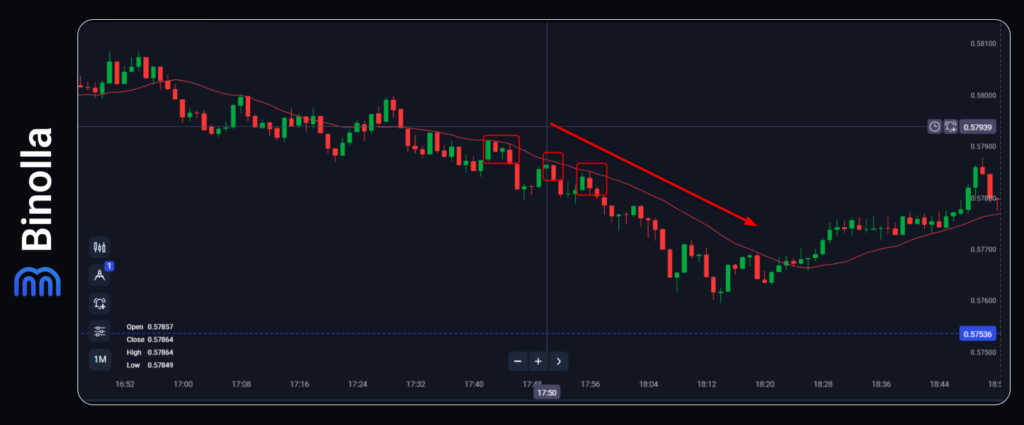
After the validity of the trend is confirmed, the next step is to wait for the price to touch the MA20. However, not all touches are equal, and this is where most traders lose money. They see the price touching the MA20, and they open a trade immediately. Before entering the market, one should clearly understand the difference between a bounce and a tap that may lead to a breakdown.
When it comes to the touch, it should be clean and clear with little noise. The best situation is when the price is very close to the dynamic line and reverses without deep piercing. However, even if there is a deep piercing, but the price reverses immediately, then the bounce is clear.
Rejection is the keyword here. You are not trading the touch. You enter the trade if and only if the price changes direction and closes above or below the MA20. In some cases, you will see candlestick patterns that may help you confirm the reversal. Some of the most popular situations include:
- Bullish pin bar forming right at the MA level in an uptrend.
- Hammer candle with a long lower wick touching the MA.
- Bullish engulfing pattern closing above the MA.
- Long lower wick showing buyers aggressively stepped in.
- The opposite formations for downtrends with bearish pin bars, shooting stars, and long upper wicks.
When trading with this strategy, wait for the simplest confirmation. We have already mentioned that touching the line is just the first step. Therefore, before placing a trade, you need to wait for the touching candle to close. Do not enter the trade before this happens. While the waiting is psychologically difficult, you should never break this rule as the candle may close below or above the MA20, which will be an unfavorable outcome.
The MA20 Binary Options Bounce Strategy Rules
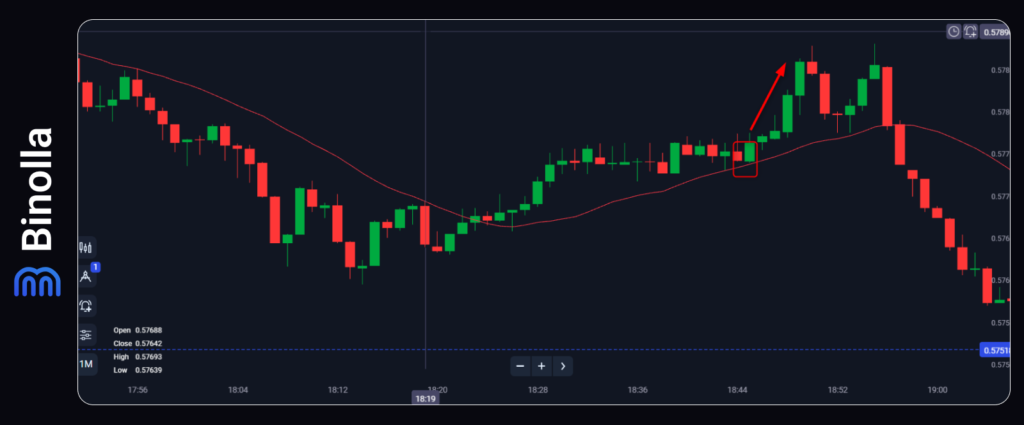
Now let’s have a closer look at the strategy that you can use in both cases. First, we are going to watch the bounce during the uptrend. The situation is typical. The price sets higher lows, which means that the uptrend is developing. At some point, there is a pullback towards the MA20, and it touches the line.
What is even more important here is that the bullish engulfing pattern is formed at the MA20, which is another confirmation of the strategy. Therefore, once the bullish candle of the bullish engulfing is closed, you can buy a Higher contract.
For binary options, that’s all. You can wait for expiration. If you are trading CFDs, then you need some additional settings to be done. First, place a stop-loss below the lowest point of this pattern. This will help you protect you trade from risks of a reversal. On the profit side, you can also set a take-profit order, which should be twice or even thrice larger than the distance between the entry price and the stop loss level.
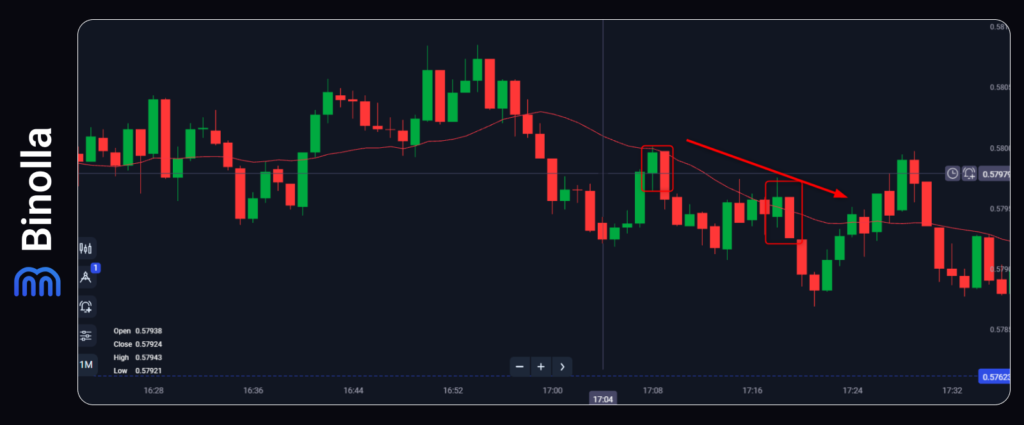
The next example of this strategy is when the price is below the MA20. You can see that it tests the moving average twice and then moves lower. In both cases, we have a bearish engulfing pattern, which confirms that the downside is possible. You can buy Lower contracts in both cases, right after the red candle of the bearish engulfing pattern closes.
If you trade binary options, that’s all. Once the trade is placed, you don’t need to do anything and just wait for confirmation. For CFD traders, it is recommended to place stop losses and take profit levels to protect themselves from risks.
The stop loss order should be placed above the MA20 and the bearish engulfing pattern. If the price moves higher, then the order will trigger, and you will avoid heavy losses. As for take profit orders, they should be placed at a distance that is twice or thrice larger than that between the entry price and the stop loss.
Key Recommendations for Trading with the Binary Options MA20 Bounce Strategy
The strategy that is described in this article is reliable, but even if you understand it clearly, you should follow some important recommendations to make the most of it. Here are some tips that will help you improve your performance:
- Watch correlating assets. If you trade EUR/USD, then you can also take a glance at GBP/USD as these currencies correlate most of the time positively. If you see the same situation in GBP/USD, then the signal becomes even stronger.
- Choose the right expiry time. Expiration is what matters the most in binary options. If you analyze the 1-minute chart and check the 15-minute chart, then you can set expiration in the range between 1 minute and 15 minutes.
- Combine with standard support and resistance levels. MA20 is a dynamic support/resistance/trendline indicator. However, to make sure, you can also add standard lines to the chart to make things even clearer.
- Limit your daily trades. Do not trade every setup that you find. The best way is to limit the number of trades to 5-10 per day. This prevents fatigue and keeps your decision-making sharp. If you hit your limit, you can walk away even if the next setup is the perfect opportunity to make another gain.
- Use alerts and pending orders. One of the benefits of this strategy is that you can plan your entries in advance. For instance, if you see that the current EUR/USD price is 1.1700 and the MA20 is at 1.1640, then you can set an alert at 1.1640, and once the price hits this level, you will see the alert and will get back to the chart. If there will be a reversal upside signal, then you will enter.
Conclusion
The MA20 bounce strategy for binary options is a robust approach that produced profits for disciplined traders. To use it, you should wait for the right market context, confirm the rejection, and choose the appropriate expiration. Moreover, you should also manage your psychology. By adding the higher timeframe analysis, you can be sure that your trades are placed in accordance with major trends, which, in turn, elevates your strategy and gives you the real edge in the financial markets.
FAQ
What is the best timeframe to use for the Moving Average bounce strategy?
There is no best timeframe for using this strategy, as you can place trades on any scale depending on your trading approach. However, if you are using a 1-minute timeframe, for instance, you should also check the trend on the 15-minute timeframe to make sure that you trade is aligned with major trends.
How much of my account should I put at risk in a trade?
The general money management rule says that traders should not risk more than 10% in a single trade. If your approach is more conservative, you can lower this amount to 1-2% per trade. Never risk more than 10% regardless of what you see on charts.
Does this strategy work on all assets?
Yes, this strategy is applicable to all assets, including currencies, cryptos, stocks, indices, commodities, etc. However, when it comes to exotic currencies, this approach may be less effective as these are low-liquidity assets and levels are less significant.
What should I do if the price touches the MA20 with a doji?
This candle indicates indecision. The market can’t decide whether to move through the MA20 or bounce. This is a clear skip signal, but you can still trade it if the next candle shows a clear bounce.
Can I use this strategy during major news events?
This is a kind of strategy that is not recommended for news trading. The reason is that the volatility and volumes may change, and even strong levels may be broken immediately. Thus, you should avoid trading 15 minutes before and 15 minutes after the news release.