Mastering Bullish Reversals: Combining Hammer and RSI

Trading with candlestick patterns is profitable, but sometimes you may see that even if you found a perfect one, it fails. Sounds familiar? While candlestick patterns are among the most popular and reliable ways to analyze markets, you can improve the performance of your trades by combining them with indicators. This article will guide you on how to use the hammer pattern together with the RSI indicator. Ready to elevate your trading? Then read it and start using this method.
Contents
- 1 What is a Hammer Candlestick
- 2 What is RSI?
- 3 RSI = 100 – (100 / (1 + RS))
- 4 Start Using this Combination with Binolla!
- 5 Why Professional Traders Combine Hammer with RSI?
- 6 Entry Rules When Combining RSI and the Hammer Pattern
- 7 Trading the RSI + Hammer Pattern Combination: A Step-By-Step Guide
- 8 Common Mistakes When Trading RSI + Hammer
- 9 Conclusion
- 10 FAQ
- 10.1 Can I use this strategy on lower timeframes like 1 minute?
- 10.2 Can I apply this strategy for buying Lower contracts?
- 10.3 What if RSI is 35 instead of 30?
- 10.4 Should the hammer be bullish or bearish?
- 10.5 Should I choose the period of the RSI indicator?
- 10.6 What if the hammer forms somewhere beyond the support level?
What is a Hammer Candlestick
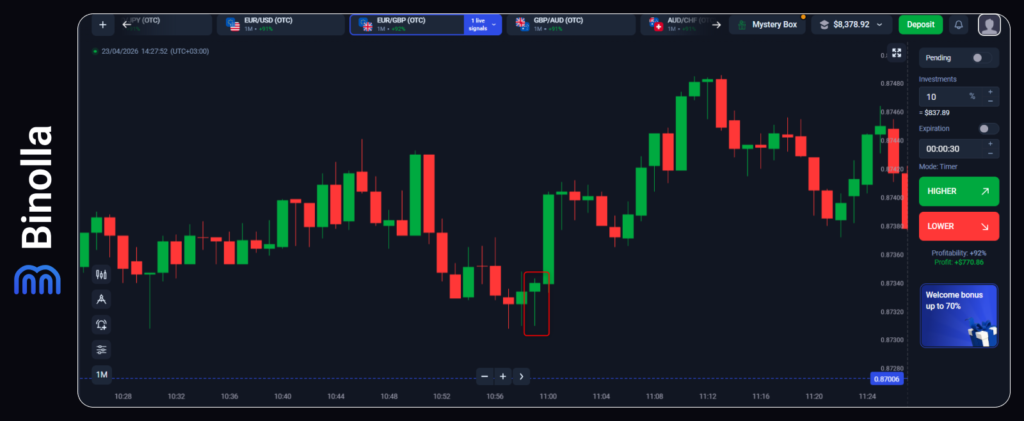
Before we delve into this working combination, let’s look at what a hammer candlestick is first. This pattern forms at the bottom of the market after a downtrend and tells market participants that the market sentiment is shifting.
The hammer pattern consists of a small body at the top and a long wick down. The upper body can also be present, but it should be small if it exists. The pattern has got its name after a tool that looks alike.
What does this pattern tell us? When a market is trading downside, sellers are in full control, and they push the price lower. Each time, new lows appear, confirming that the downtrend is in full swing. However, at some point, the price goes upside down within a candle, showing that buyers are getting stronger. If this candle closes with a long tail and a small body, it is known as a hammer, and it shows that sellers are unable to move the price lower.
At this moment, the market sentiment shifts, and buyers can push the price higher. Keep in mind that the hammer pattern is formed at the support level, which means the area where the price stopped and reversed previously. This means that a reversal may occur again, and the pattern confirms such a probability.
While the pattern is considered very reliable, it may fail in some cases. If sellers are strong enough and the market sentiment is powered by some important macro news or geopolitical events, even a perfect hammer pattern at the support level may give you a false signal. Therefore, to be more sure about your next move in the market, you can combine it with indicators, including the Relative Strength Index, or simply RSI.
What is RSI?
The Relative Strength Index is a momentum indicator (oscillator) developed by J. Welles Wilder to measure the speed of change of price movements. The indicator is built in a separate window on a scale from 0 to 100.
The indicator is calculated automatically according to the following formula:
RSI = 100 – (100 / (1 + RS))
where RS is the average gain over X periods / Average loss over X periods, the number of periods is typically 14, but you can set it on your own.
To make it simple, the indicator compares the closing prices. If they are mostly higher, then the indicator rises. When most prices of the period are lower, then the indicator plunges.
To use this indicator together with the hammer pattern, you should know about overbought and oversold areas. Oversold is when the RSI is below 30. The asset falls sharply, and an upside bounce is possible. When it comes to situations when the indicator rises above 70, the price is overbought. Therefore, traders can expect the price to move lower.
When the indicator is between 30 and 70, it is in the neutral zone. No extreme conditions means that the price may either continue to move higher or reverse and develop a downtrend.

Start Using this Combination with Binolla!
Join Binolla and apply this and other strategies for profitable trading
Join nowWhy Professional Traders Combine Hammer with RSI?
Now that you know more about both tools, it is time to understand why professionals often combine them. The hammer pattern is a perfect analysis tool on its own. It shows when the market sentiment may shift, and buyers may step in. However, it is not always enough to watch the hammer pattern alone.
The RSI Filter
The RSI is often used as a filter to augment your hammer pattern strategy. When the indicator is below 30, this means that the asset is not just falling, but it is stretched to the downside. However, at the same time, the asset is trading in the oversold area, which means that the probability of a bounce increases significantly. You should think of it this way: when a hammer pattern appears, buyers become stronger and try to regain control. However, there is still no guarantee that the price will move higher. When you add the RSI indicator, you add more confidence in what you do. Think of it this way:
- The hammer pattern. Market sentiment is shifting as buyers are stepping in.
- The RSI indicator. The price of the asset may be low enough to consider.
- Hammer and RSI are used together. The market sentiment is shifting, and the asset is cheap enough. Therefore, a reversal is more likely to occur.
Entry Rules When Combining RSI and the Hammer Pattern
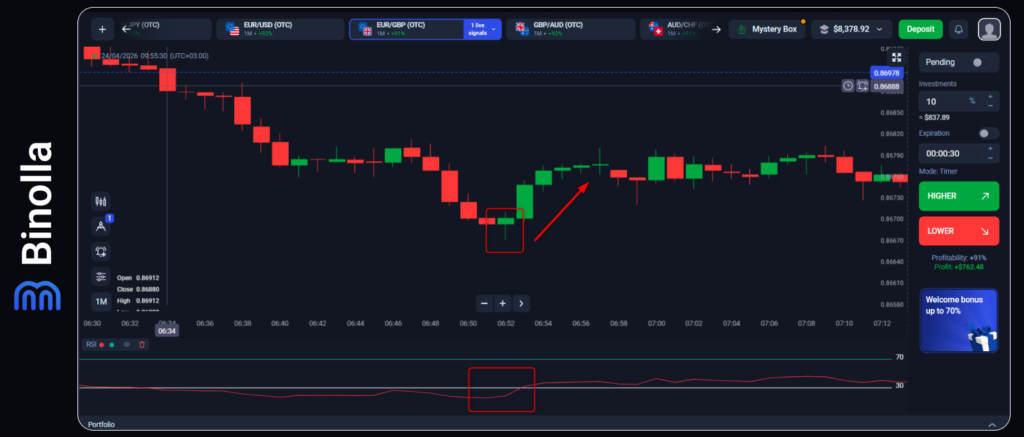
So now that you know more about both tools that we are going to combine, let’s look at entry rules so that you can apply this in practice. First, before entering, you should check whether the following conditions are met:
- Downtrend before the hammer pattern. The price should decline for some time before the hammer pattern forms at the bottom of the market.
- The hammer pattern forms near the support. The next important sign of a good hammer pattern is formed near the support level.
- RSI below 30. The RSI indicator should move below 30 and stay there for a while.
When to Enter a Trade
Now that all the conditions are met, the next step is to open the trade. You should wait for two key triggers. The first one is when the next candle breaks above the hammer pattern. You can place a market order or even a pending one (by the way, if you are trading binary options with Binolla, you can place a pending order as well; the Higher contract will be opened once the price reaches the level). The RSI indicator should be in the oversold area (below 30) at this moment.
Keep in mind that if you place a trade right after the hammer pattern close, this is not a mistake. However, false breakouts are possible in this case, which may lead to losses.
If you are trading binary options, that’s all. Now you can just sit back and wait for the outcome. However, CFD traders should also think about how much they can afford to risk and where to close a trade. Therefore, you should place a stop loss to protect yourself from excessive losses. A stop loss order can be placed below the hammer tail, or you can also calculate it according to your risk-to-reward ratio.
When it comes to the take profit order, set it according to your risk-to-reward strategy as well or just use a resistance level above to plan where you are going to exit a trade.
Trading the RSI + Hammer Pattern Combination: A Step-By-Step Guide
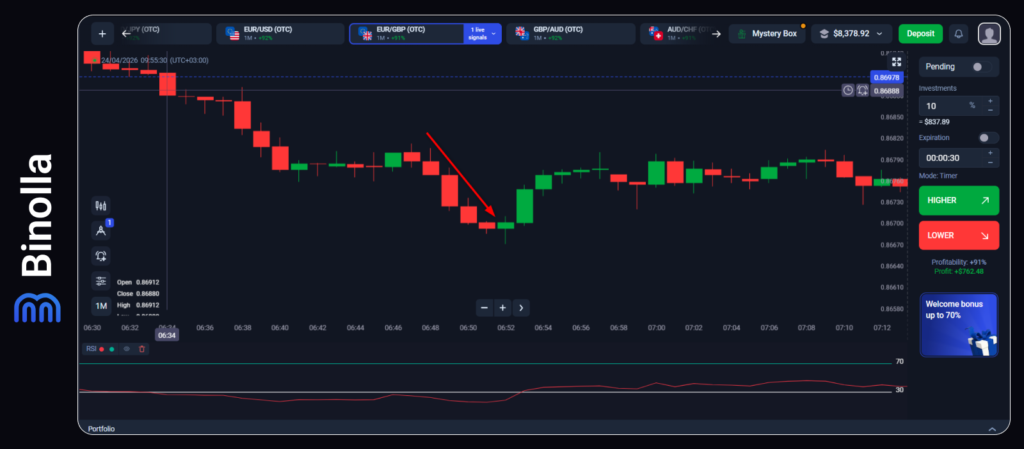
So, to understand how to use this approach, we have prepared a detailed guide. First, you need ot identify the downtrend, which you can clearly see on the screenshot. Remember, the hammer pattern appears at the bottom of the downtrend. Therefore, spotting a downside movement is essential.
Spot the Hammer Pattern
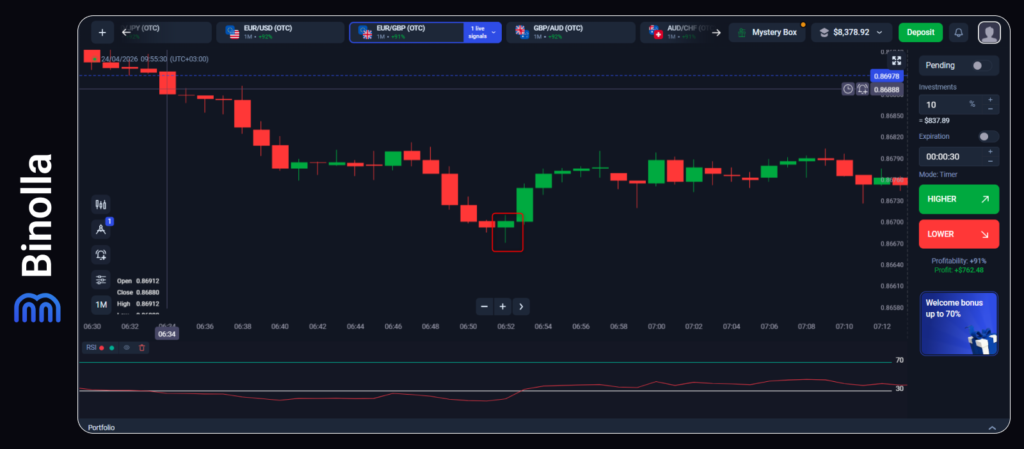
Next, you need to spot the hammer pattern. If you see a candle with a long downside tail and a small body at the top, then you have found what you were looking for. As we have already mentioned, a hammer may also have a small upside-down wick, which is also the case in this example. Wait for the pattern to close first to make sure that this is a hammer.
Check the RSI Indicator
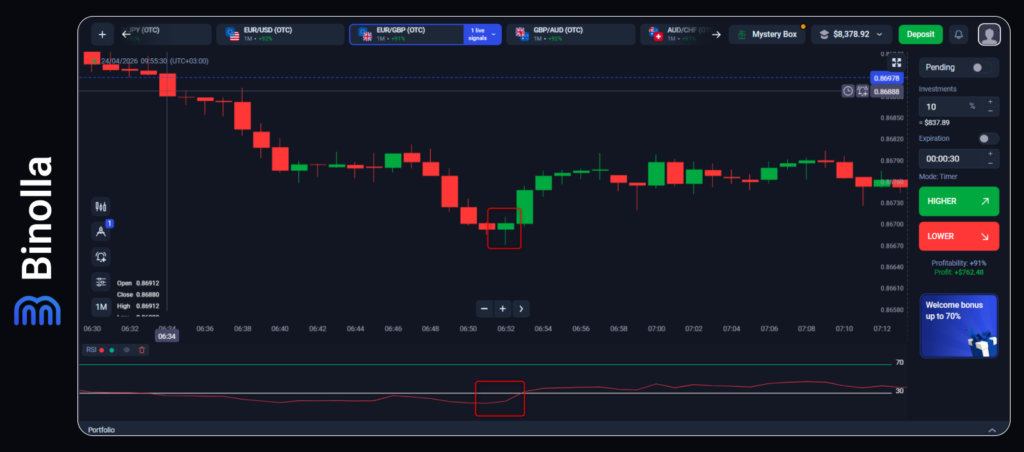
Your next move is to check whether the RSI indicator is oversold. In our example, you can see that the line of the indicator is below 30, which is a clear signal of the oversold condition. Therefore, you should prepare for trading.
Place a Trade
Now that you are sure that you have a signal confluence (RSI is oversold and the hammer pattern is formed), you should wait for the next candle to break above the upper point of the hammer. Once this happens, buy a Higher contract or purchase an asset.
Common Mistakes When Trading RSI + Hammer
While this combination is reliable, you should keep some things in mind to avoid mistakes. Here are the most common failures that you shouldn’t ignore:
- Ignoring the major trend. The downtrend before the hammer is a very important condition. If there was no previous downside movement, you may not rely on the pattern itself. Before even considering a hammer, make sure that it is preceded by a downtrend.
- RSI is not oversold. If you are using this combination, you should make sure that RSI is oversold, i.e., the line is below 30.
- Placing stop losses too tight. Those who trade CFDs should not place stop losses too close to their positions. The order may trigger due to volatility and you will be out of the market.
- Forcing trades with no setup. Sometimes, traders think that they see a hammer pattern, but in reality, they want to be in the market, and they try to align every pattern with the hammer. You should check the pattern before opening a trade. It should have had a long wick down and a small body up.
- Overtrading after one win. One profitable trade does not mean that you are invincible. You may get overconfident, but you should never forget about risks. Also, make pauses to breathe and to analyze your trading routine.
Conclusion
The hammer pattern is a very strong candlestick formation, which tells you that the market sentiment is shifting. Even used alone, it can be quite a good predictor of a reversal. However, not all hammer patterns are valid, even if they look perfect and form at the support level after a downtrend. Combined with RSI, the hammer pattern becomes an even stronger predictor of the market reversal. Confluence, in this case, is what can improve your trading strategy and help you make more informed decisions. However, to make the most of it, you should also use a money management strategy that will allow your balance to grow over time.
FAQ
Can I use this strategy on lower timeframes like 1 minute?
Yes, this strategy is universal and does not depend on the timeframe. While on longer timeframes, the market noise level is lower, you can still apply it with a high probability of success on lower timeframes, including 1 minute. Moreover, you can also adjust RSI settings by lowering the oversold area to 25 or even 20 instead of 30.
Can I apply this strategy for buying Lower contracts?
Absolutely. However, you should keep in mind that the price should grow and then you should find a shooting star pattern, before entering. Also, the RSI will be in the overbought position (above 70 or 80) to confirm that the reversal is near.
What if RSI is 35 instead of 30?
If the RSI indicator has not reached the oversold area, you can still place a trade as if you were trading without this combination at all. However, you should keep in mind that the momentum is weaker in this case and the price may not reverse after the hammer candle, but continue to move below it.
Should the hammer be bullish or bearish?
The color of the hammer pattern does not matter at all. It can be either red or green and this has no impact on the outcomes. However, some traders prefer only green hammer patterns as they think they are stronger reversal signals. Anyway, you can use any as they are of equal meaning.
Should I choose the period of the RSI indicator?
In general, you can use the default settings when applying this strategy. Wilder used 14 period, and this setup stood the test of time. Some traders use 9 periods as they want the indicator to be more sensitive and give more signals. However, you should prepare for filtering false entries in this case.
What if the hammer forms somewhere beyond the support level?
It is better not to trade in this case. A strong hammer pattern forms at the support level. Everything else is not confirmed, as market participants do not evaluate the pattern itself but whether it reaches a level where demand may increase and supply decrease accordingly.