The Labor Data Trading Manual

The labor market data stands alone among all other macroeconomic indicators for many reasons. However, the main reason is that it often creates much volatility, which, in turn, may lead to significant one-sided price movements. This allows binary options traders to make money on these fluctuations whether they trade currencies, stocks, indices, or even metals. By reading this guide, you will learn more about the basics of labor market data in binary options trading and learn how to use these statistics in your trading routine.
Contents
The Most Popular Labor Data Indicators
There are plenty of labor data indicators across macroeconomic calendars, and sometimes it feels frustrating when you try to trade all of them. Not all such data sets have the same impact on prices. Therefore, a lot of beginner traders fail just because they chose the wrong data for trading. To make it clear, you should read the following parts where we break down the most popular labor data indicators that are more likely to result in volatility bursts.
Non-Farm Payrolls (NFP)
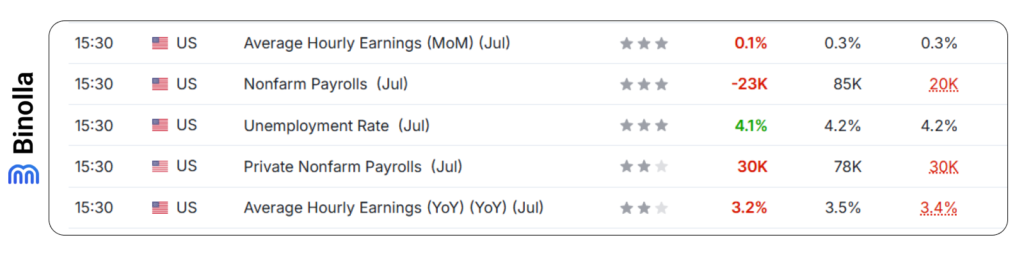
This is a true leader in the world of trading, which is comparable to Central bank meetings or inflation releases. The NFP report shows how many new jobs were added for the reported period. A number above 200,000 is generally considered strong, while negative figures point to weakness of the labor market in the United States.
However, even with those figures in mind, the market does not care about them as much as it cares about the surprise. If, for instance, 150K new jobs were expected to be created and the final NFP release shows that only 60K new jobs were added, then the market will react immediately. USD will fall, stocks may rise, and gold may also go higher hand-in-hand with oil and other assets.
The secret? Data was significantly below expectations and market sentiment changed. Therefore, when trading NFP and other labor market data releases, you trade the gap between expectations and reality, not the figures themselves.
Along with NFP, it is worth paying attention to Average Earnings and the Unemployment Rate. On Thursdays, Unemployment Claims data is released in the US. It shows how many new unemployment claims appeared for the past week.
Claimant Count Change in the UK
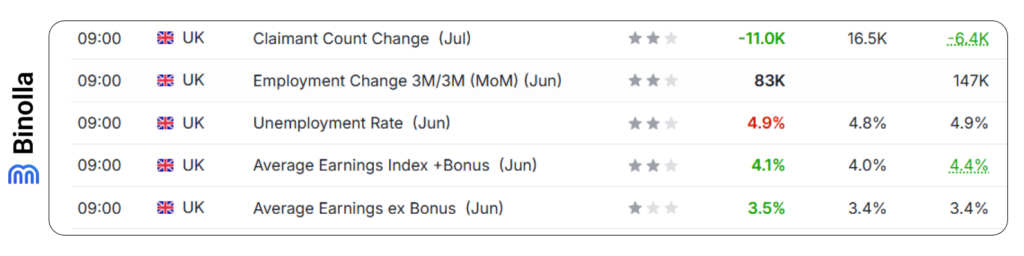
This is the analog of the US Unemployment Claims data, but released on a monthly basis. Similar to the US data, if the number of those who claim unemployment benefits increases, the pound will fall, while lower rates may support the British currency. When trading Claimant Count Change data, keep an eye on forecasts and current readings. If they differ significantly, this may lead to higher volatility.
Another important labor market release in the UK is the Average Earnings Index. A rising index tells traders that inflation is accelerating, which, in turn, may push the Bank of England to hike rates. As you may guess, the pound will gain support in this case, especially if new figures come with a gap to forecasts. Lower rates, in turn, tell traders that inflation is slowing down, which may spur the regulator to hold current rates or even cut them.
Eurozone Unemployment Data
Eurozone employment data is more complex, as you may find an aggregate unemployment rate for the whole union and separate German figures. But the rule is simple: focus on German unemployment data as this country has the strongest economy and market participants focus on German labor market data instead of looking at the whole picture.
Along with these three key indicators, market participants often look at Australian, Japanese, and New Zealand data. Also, they check Canadian data if they trade the CAD.
How to Trade the Employment Data Releases
Now that you know the basics and the main labor market indicators, it is time to move further and look at how to trade the release. The good news is that you don’t even need any knowledge in economics to deal with it. Binary options traders often check the calendar in advance and prepare themselves beforehand.
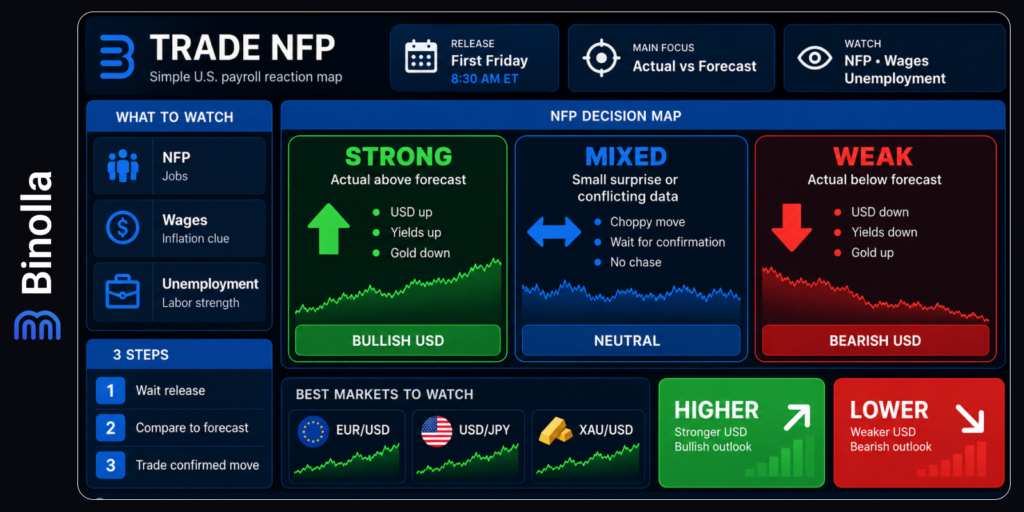
So, what should you look at first? Let’s make it clear based on NFP reports. So, first, you should check the calendar on the first Friday of the month. If you see the US labor market there, then you can start preparations. Even before the data is released, you should watch the direction of the forecast.
If NFP is expected to be above the previous reading, then forecasts are positive for the US dollar and negative for pairs like AUD/USD or EUR/USD. On the other hand, if forecasts are negative, like a lower number of new jobs is expected to be added, then it is not good for the US dollar, but perfect for pairs like GBP/USD or even for gold and indices.
When to trade the release? There are various strategies that traders use. The first one is the most clear. You open a trade right at the moment when the fresh data appears. This strategy is the simplest one to grasp. You just refresh the browser tab with your economic calendar, watch the fresh figures and their color (red for a negative outcome and green for a positive), and then you buy a Higher or a Lower contract.
Imagine that the forecasted NFP was 150K new jobs but once you refresh the tab you see that only 70K jobs were added. Then you just press the Lower button if you trade the dollar index or the Higher button is you trade EUR/USD, for instance.
On the other hand, if 50K jobs were expected, while the final reading is 90K, then you buy a Higher contract for the US dollar index and favor the US dollar in all other currency pairs. Gold will likely to move lower in this case.
The expiry time should be set according to your strategy. Remember that the first reaction is quick, so you can even trade 1-minute options expecting the move to be significant and protect your trade from a pullback, which could reach your strike price.
Another strategy that traders apply is to enter beforehand. Just one minute before the release and cover the release itself. This time, you watch forecasts and try to predict whether the final reading will be above or below predictions made by economists. This strategy is more like a game as you can’t know in advance the fresh figures. Therefore, it adds more risks, and you should apply it carefully.
So, to trade with this method, you look at previous readings and forecasts. If the forecast is below the previous reading, then you buy a Higher contract expecting that the forecast will be right and you will just catch the movement at its beginning. Conversely, if forecasts are above the previous reading, then you buy a Lower contract.
Keep in mind that the momentum after such news releases lasts for up to 10 minutes, which means that you can trade in the same direction many times, which increases your eventual profits.

Place You Next Trade on Labor Market Data with Binolla
Join Binolla now and use the labor market data to benefit from volatile statistics
Join nowThe Different Examples of How Markets Behave During Labor Market Releases
To make it even clearer about how to trade NFPs and other jobs reports, let’s look at the three different scenarios where you can apply different strategies right after the release.
Example 1: The Clear Beat
This one is the easiest for trading. The consensus may be 150K, but the final result beats it by 100K, for instance, and reaches 250K. When the number comes out, the US dollar spikes up, and it is a good opportunity to buy a Higher contract to make money on this movement. The key here is to get in early to ride the main wave.
Example 2: The Miss
The next scenario is when the NFP consensus is 180K and the actual reading is 120K. In this case, the US dollar index is likely to dive and you can make money on this movement. All you need is to join the downside by buying a Lower contract as fast as you can to catch the initial movement. While in binary options you don’t count pips, by entering earlier, you will have more chances for succeeding in this trade.
Example 3: Previous Month Revision
The next and the most unfavorable scenario is when the consensus is 180K, for instance, the actual print is 210K, and the currency spikes up, but in a matter of seconds it reverses as the previous reading was downgraded to 50K. The net effect will become bearish in this case, which means the upside would stop and the downside may develop. If you see the revised reading, then you should make decisions based on this reading and the whole picture.
How Central Banks Are Connected to This Data
To make everything even clearer and allow you to make weighed decisions, it is worth looking at what drives prices after the release of the labor market data. Central banks watch this data closely before making any further interest rate decisions.
The Fed, for instance, has a dual mandate. They maintain maximum employment and stable prices. When the NFP or unemployment rate is strong, the Fed feels comfortable raising rates. Higher rates make the dollar more attractive. When the employment data is weak, the Fed may cut rates, and the dollar goes down.
In the United Kingdom, the Bank of England looks at employment data and wages closely. They worry about inflation more than anything else. When the Average Earnings Index comes out high, the British currency gains support as market participants expect the BoE to hike rates or at least stick to its current strategy.
In the Eurozone, the ECB is not as aggressive as the Fed. While they look at German jobs data, they evaluate the results and whether the labor market adds new jobs or the unemployment rate decreases; then the Euro tends to rise.
Conclusion
Trading binary options on labor market data is among the most reliable ways to profit in the financial markets. Traders and investors watch this data closely, and each release may increase volatility significantly. People panic on bad news, and they start to sell, while good news supports prices. A trader should avoid being emotional. They should make decisions based on figures. As it was already mentioned, to trade labor market data, you don’t need to know everything about economics. You just need to know data releases that matter for the countries whose currencies or assets you trade. You also need to know consensus (which you can find in every economic calendar) to make the final trading decision.
FAQ

What is the best expiry time for trading labor data with binary options?
Traders choose expiry according to their strategies. You can trade various types of contracts depending on your expectations. For instance, if you are a good scalper, you can choose a 1-minute contract and catch the initial movement. However, you should keep in mind that 15-minutes expiration is riskier, as the pullback after the news release may reach the strike price.
How do I find the consensus numbers for different countries?
You can find this data in any economic calendar. Moreover, we always post the most important weekly news releases on Monday, which allows you to stay aware at any moment.
Should I trade the same asset for every labor data release?
No, you can choose the asset on your own. If you are trading the NFP release, then you can choose any major currency pair with USD, commodities, stocks, and others. For Canadian labor market data, you can trade USD/CAD and other loonie-related currencies.
Why does the price sometimes spike in the wrong direction initially?
This is due to market sentiment and other important data. Keep in mind that not everything depends on figures in a specific situation. The price may be affected by many other factors, including the current central bank policy and broader economic data. Moreover, a surprising NFP may not be a trend, but only a seasonal correction. Which means that even if the figure does not support the whole trend, it may not be considered by the market.