Round Numbers and Psychological Levels in Binary Options
Have you ever noticed how the price may strangely behave when it reaches some specific levels like 1.1000 or 156.00? If yes, you are on the path to learning one of the most important concepts in trading. Round numbers and psychological levels are what make binary options trading more predictive and accurate. Not just simply because of the beauty of these zones. These levels contain some useful information that may tell you how the market will behave later. In this article, we’ll delve into why round numbers are important and how to use them in binary options trading.
Contents
- 1 Why Round Numbers Matter
- 2 The Magnet Effect of Round Numbers
- 3 The Barrier Effect of the Round Numbers
- 4 Start Using Round Numbers in Your Strategies
- 5 Which Round Numbers Are Stronger
- 6 Breakouts Through Round Numbers
- 7 Examples of Round Numbers in Trading
- 8 Practical Rules and Recommendations and Rules to Consider
- 9 Conclusion
- 10 FAQ
Why Round Numbers Matter
First, let’s delve into psychology and see why these round numbers even matter in trading. Markets are not pure math machines. They are driven by crowd psychology. For instance, when important news dominates the headlines, traders and investors move the price in the chosen direction. Not all together, but this can create a strong trend. When it comes to round numbers in trading, the same applies.
When you trade CFDs and set take profits, you don’t want to put $99.87 into your pocket. You set a level to gain $100. This amount is easier to understand and communicate. This behavior creates a cluster of orders at specific levels. The thing is that not just retail traders behave like that. Institutional investors like banks, hedge funds, and even central banks often target round numbers as they are easier to grasp. The recent US-Japan yen intervention only supports this idea. According to officials, they looked clearly at 160.00, not 159.98, not 161.05. The level was 160.00.
This results in one important concept in trading. Round levels weigh more than others and this is not magic. They are noticeable and often chosen by various types of market participants as targets for their profits or zones where traders and investors want to limit their risks.
The Magnet Effect of Round Numbers
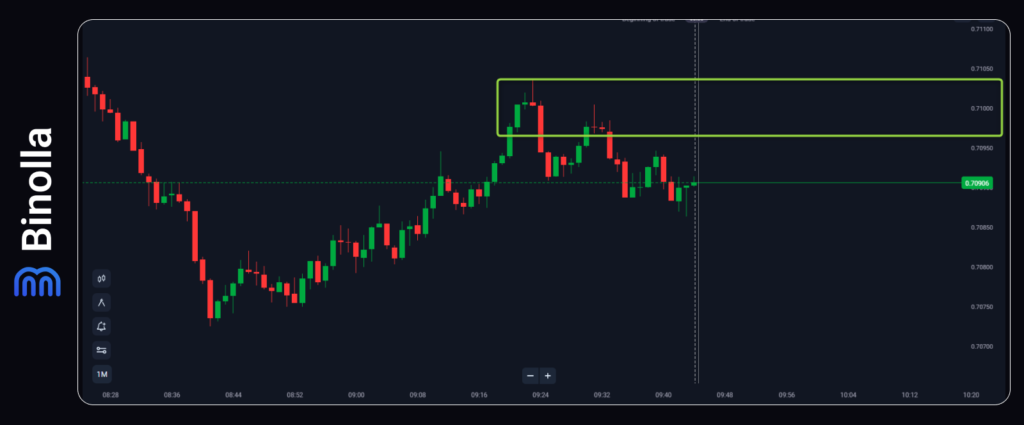
Now that you know more about round numbers, let’s delve even deeper to explain the magnet effect. If you look at price behavior when quotes are close to round numbers, you will notice that the price may drift toward these numbers quickly if there is no strong opposing force. This happens for many reasons:
- Order clusters. Both retail traders and institutional investors often use round levels to place their orders. For instance, they may want to buy EUR/USD at 1.1500 or sell it at 1.2000 depending on the situation and their view. Therefore, rich supply and demand clusters will be located in these zones.
- Trading algorithms. Robots, including high-frequency trading systems used by large institutions, are often programmed for round orders. Therefore, they create supply and demand clusters in these zones independently, which creates even more reasons for the price to reach these levels.
- Frame of reference. For those who are not yet in the market, but plan to enter, when they see the price float somewhere at 1.0984, they feel uncertain. They will wait for the closest round number to decide on their future trade.
- Self-fulfilment element. A lot of traders just believe in round numbers (not in vain, by the way). Therefore, they prefer to trade when the price reaches them.
The Barrier Effect of the Round Numbers
Round numbers act not only like a magnet. They also “protect” higher or lower levels from being reached. And this is the second important feature of this phenomenon. When the price approaches a round level from below, it typically faces a wall of sell orders. This wall comprises both retail traders who view this as a resistance level and institutions who want to fade the move. In some cases, the first test ends with a rejection.
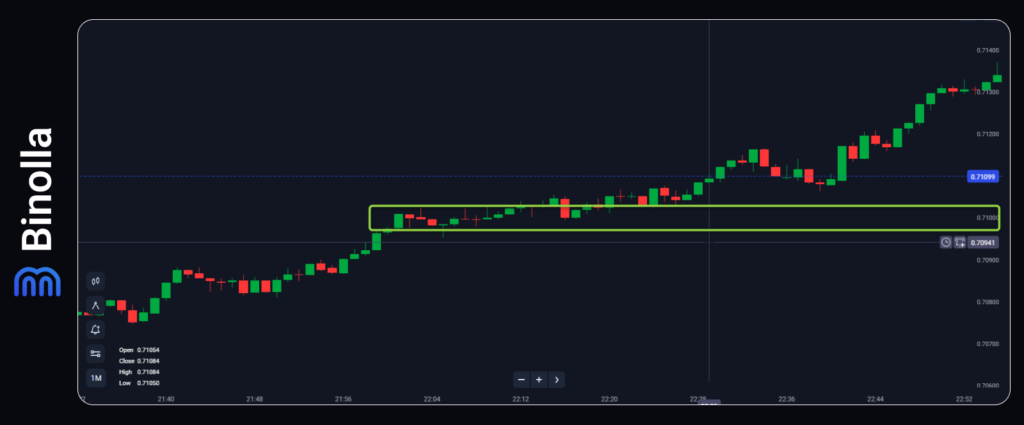
Next, the further development of the situation depends on how market participants view the situation. Looking at patterns and fundamentals is also very important in this case, whether you are trading binary options or CFDs. If fundamentals favor the asset, the price is likely to break above after the rejection and continue the upside. On the contrary, if the event is negative for the asset, then the rejection may develop into a full reversal.
The barrier effect is the strongest when the price approaches the zone for the first time or was there long ago. A level that was touched five times in the last hour has already absorbed most of defending orders and is likely to be broken.

Start Using Round Numbers in Your Strategies
Join Binolla and enjoy top-noth trading with a reputable brokerage
Join nowAnother thing that you should keep in mind is that the barrier effect is also stronger when the price goes closer to the round number with declining momentum. This means that the dominating side loses control, and when it meets the opposite side with opposite orders, the price reverses sharply.
There is one more thing that is worth noting. The strength of the barrier also depends on the time of day. For instance, during London or New York sessions, round levels are protected more aggressively due to larger volumes and liquidity. During the Asian session, things may change significantly as liquidity is lower and the number of defenders is lower, which means a clean breakout is possible without any significant resistance.
Which Round Numbers Are Stronger
Round numbers can be 1.100, 1.150 or even 1.155. So traders often ask a question about which one is stronger so that they can use them in their strategies. Round numbers like 1.1000, 1.500, 155.00 or 5,000 are known as major levels. As you may guess, they are the strongest ones. For binary option traders, this means that if the price approaches one of these levels, they can make money on both short-term rejection and further breakout (if the latter occurs). Chances that this strategy will work increase significantly.
When it comes to intermediate levels like 1.150, 155.50, or 4,050, they are less strong. They often produce more hesitation, but they can be broken in a more decisive way. Therefore, when the price approaches them, a trader can look for both reversals and breakouts.
Finally, minor numbers like 1.125, 4,025, or 155.25 are almost unnoticeable for traders. If you see a support or resistance at one of these levels, you should treat them like standard support or resistance without giving them more weight.
Breakouts Through Round Numbers
This is the most important part of trading with round numbers. Breakouts occur often, especially when fundamentals support. When opposite orders trigger close to the round number, a rejection occurs, as we had already mentioned. However, if buyers or sellers have enough power, then they absorb this reversal, and then the price continues to move in the previous direction.
What is important here is that once a breakout occurs, the movement will definitely accelerate at some point due to the fact that stop losses trigger.
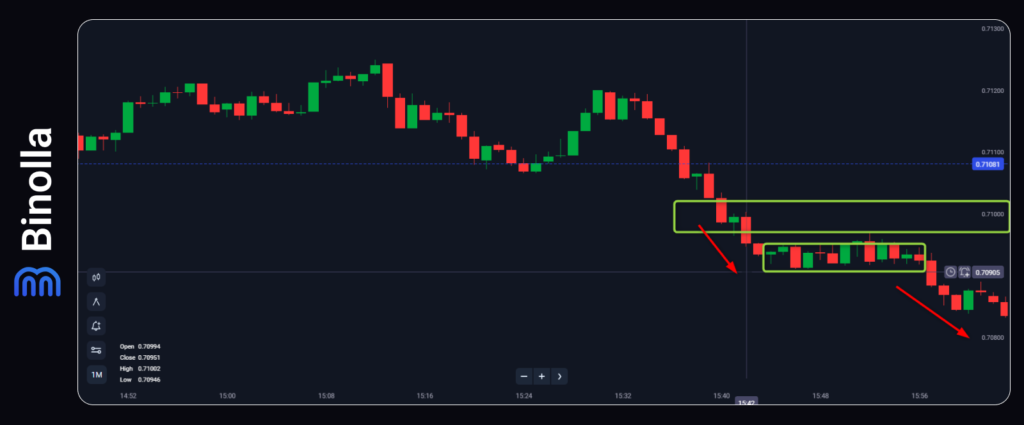
In our example, you can see that the price moves close to 0.7100 from above and makes a couple of stops there with green candles (bullish traps). But in both cases, the downside continues until the price stalls in a tight range.
Therefore, if you placed a Lower order above 0.7100 expecting the price to test the level, you would make profits. If you decide to join the rejection in this situation, you will lose. Remember that this is like trading against the main trend.
Next, you see that the price is trying to get closer to 0.7100, which is a magnet round level for the quotes. Here, stop losses are located. Some of them trigger (which means that buyers are off the game), and some orders may be closed manually. But what is important here is that at some point, sellers gain enough power to continue the downside, and here you can place a Lower trade to join the movement.
The strategy here is very simple. You just draw support and resistance for this tight price rectangle and just wait for a clear breakout (when the price moves below the support level and closes there) to place a trade. As you can see, the price continues to set new lows afterwards.
What is the key takeaway from this part?
- The price may pause its movement when it reaches the round number.
- You should either skip these pauses or trade during them depending on the situation.
- A consolidation may develop close to the round number as it acts as a magnet.
- Wait for the price to go beyond the consolidation formation before placing your next order.
Examples of Round Numbers in Trading
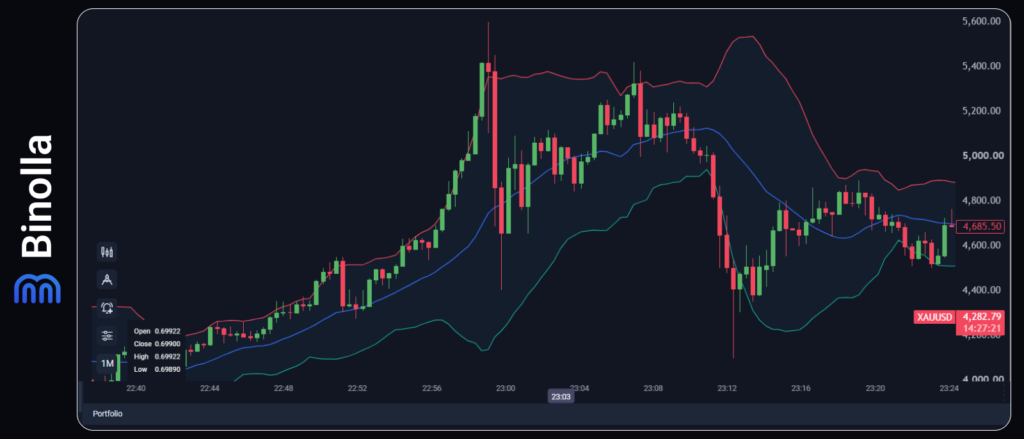
Now that you know about round numbers in trading, let’s look at some of the examples. The first one is gold. The price tested $5,400 and $5,600 this year, both being round numbers. As you can see, these were strong resistance zones, with a lot of sell orders in place, as later, after a couple of tests, the price moved lower and never reached the numbers again.
Bitcoin, another popular asset so far, was fluctuating between $60,000 and $70,000 this year, with both round numbers being strong zones of demand and supply. Later, Bitcoin moved towards $80,000 and stopped at $82,000, another strong round number zone.
When it comes to the S&P 500, a major US index, it hovered below 7,000, which is a significant psychological zone, and later moved above. The next round number will be at 7,800.
Practical Rules and Recommendations and Rules to Consider
Before we end this article, we have some useful recommendations that may help you better deal with round numbers in binary option trading. Learn them and apply them in your strategies to improve your trading results:
- Levels like 00 or 50 (major and intermediate) should not be considered as simple levels but as zones, which means that the price may fluctuate within a tight range close to these areas. Therefore, you should not consider just 1.1000 as a round number for trading. The price may reach 1.1000 and even 1.1003 and then reverse during the rejection stage.
- Trade with shorter expiration when the price is within these zones. If you trade during the rejection phase, then you should understand that it can take from 1 candle to several. But not too long. Therefore, place your expiries accordingly.
- Watch how the price approaches the level. If momentum fades, then chances for a breakout are very small, and a pure reversal is possible.
- Respect major and intermediate levels. Major levels like 00 are stronger than intermediate levels like 50.
- Prefer fresh levels to those that were tested several times during the last hour.
Conclusion
Round numbers are not a strategy themselves. They are not a clear system with clean entry points that you can use. However, they can be a great update to any method that you apply, as they tell you more about market movements than standard support and resistance levels. When the price approaches one of these levels, you can be sure that both retail traders and institutions watch it closely, and some important events are on the way. Next, you can apply various strategies, including candlestick patterns and indicators, to read such situations. By using this approach, you can significantly improve your chances of profiting in binary options trading.
FAQ
Are round numbers more important on higher timeframes?
Round numbers are of equal importance regardless of the timeframe you look at. However, as you probably know, smaller timeframes offer higher levels of noise. Therefore, you should consider this information before making any trading decisions.
Do round numbers work on various assets?
Yes, sure. Round numbers work on all assets that are traded on exchanges and markets. However, for some volatile assets, the round number zone may be wider and reach even 20-30 pips as compared to more liquid and less volatile financial instruments.
Should I fade the first test of a round number?
No, fading the first test is not necessary. You should watch the situation and act accordingly. However, you should keep in mind that trading against a strong price movement may be very dangerous.
Do round numbers matter more in low-volatility or high-volatility markets?
They matter regardless of the volatility. However, volatility may impact how you will trade in each particular situation. Higher volatility may widen the round number zone.
How do I know that the round number is fresh?
Check how many times the price touched the level for the past 24-48 hours. Also, some round numbers remain untouched for years and you will see them clear on charts.