Marubozu in Binary Options and CFD: A Powerful One-Candle Pattern for Profitable Trading

The marubozu pattern is a powerful candlestick formation that is very popular among traders worldwide. It is known for its high reliability, as it is confirmed by high volumes that you don’t even need to confirm, as the volumes are confirmed by the candle itself. In this article, you will learn more about marubozu and how to apply it for binary options and CFD trading.
Contents
- 1 What Is a Marubozu Candle?
- 2 Bullish Marubozu: How to Identify the Pattern
- 3 Bearish Marubozu: What It Looks Like
- 4 Bullish Marubozu Trading Strategy
- 5 Start Trading with Marubozu at Binolla!
- 6 A Bearish Marubozu Trading Strategy
- 7 Common Mistakes When Trading the Marubozu Pattern
- 8 Best Recommendations for Trading Marubozu Candlestick
- 9 Bullish vs Bearish Marubozu Comparison Table
- 10 Marubozu vs Other Candlestick Patterns
- 11 Conclusion
- 12 FAQ
What Is a Marubozu Candle?
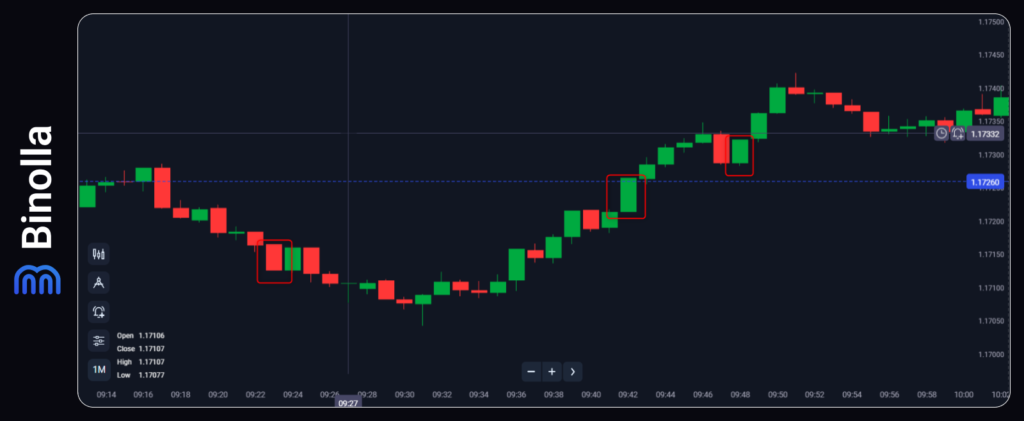
A marubozu candlestick is a special type of candle with no wicks (or very small wicks). The body of the candle represents the full range from open to close, which means that one side is dominated by the end of the session entirely. In most cases, a marubozu is formed with higher volumes as buyers or sellers push the price in their direction without any chances for the opposite side to change the situation.
The key characteristics of the marubozu candle include:
- No upper wick
- No lower wick
- Long body
- Strong buying or selling pressure
The marubozu candle can be frequently found on charts during the uptrend or the downtrend. When finding it, professional traders know exactly what to do, as this is a great opportunity for them to trade along the trend without any additional tools. You don’t even need levels to benefit from the pattern.
Bullish Marubozu: How to Identify the Pattern
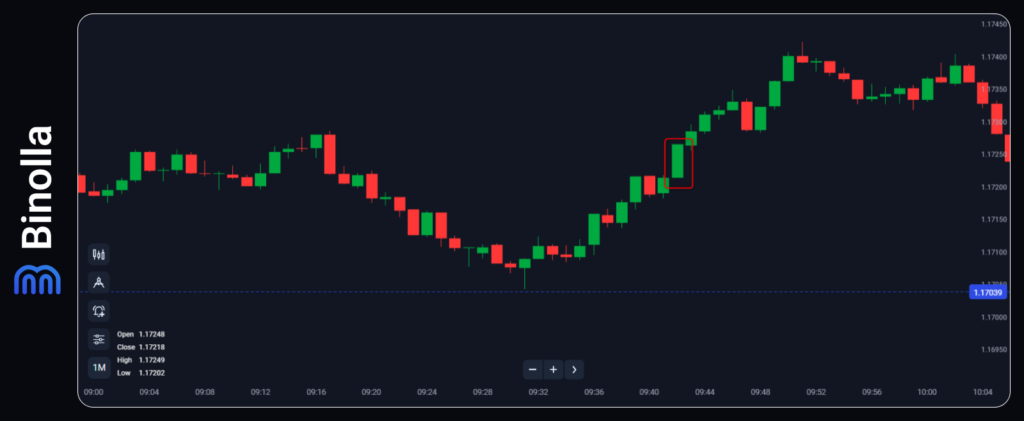
First, let’s have a closer look at the bullish marubozu pattern. It is formed during the uptrend after a reversal. To be more accurate about the pattern, you should look at the following parameters:
- Long green body
- No upper wick at all
- No lower wick (or a small lower shadow showing that buyers were dominating almost all the time)
The bullish marubozu pattern tells traders that buyers were controlling the market almost all the time during the period. While some pullbacks could occur, the candle closed far above the open level. The pattern is a strong signal that the uptrend may continue.
Bearish Marubozu: What It Looks Like
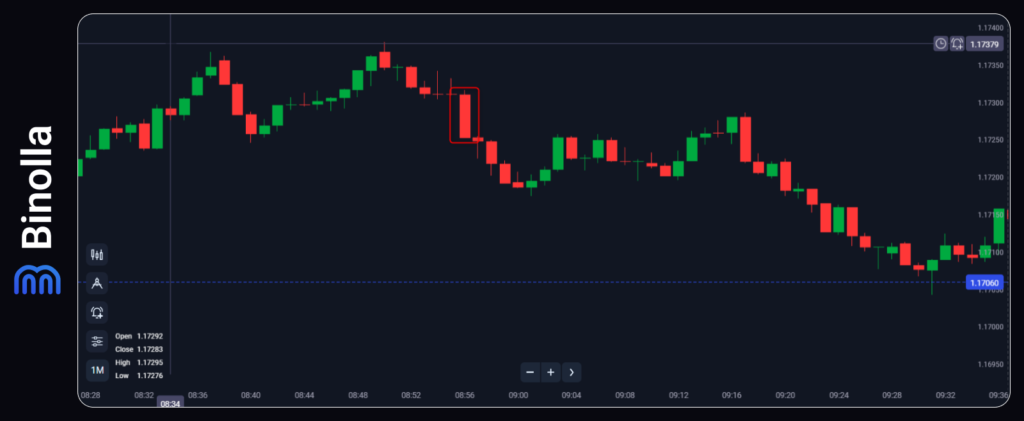
The next pattern that we are going to consider is a bearish marubozu, which is the opposite of a marubozu formation to a bullish one. It forms during a downtrend and has the following features:
- Long red body
- No lower wick
- No upper wick (or a small upper shadow)
When you see this pattern, you can be sure that the market was bearish throughout the whole period. Sellers pushed prices continuously and closed at the lowest point, which allows you to suggest that the price will continue to move below.
Bullish Marubozu Trading Strategy
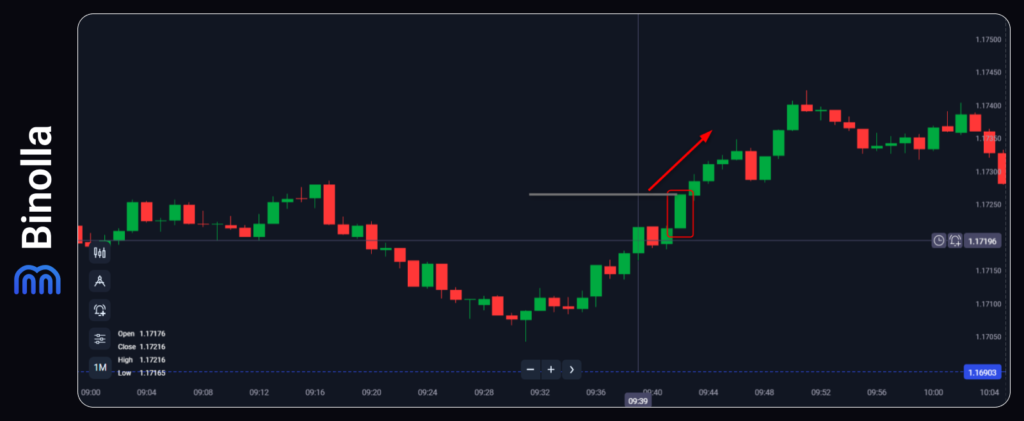
Trading with a bullish marubozu pattern is very simple if you know how to identify it. So first, you should wait for a candle with higher volumes. You will see it even without any indicators, as it will be longer than most other candles during the trend. Once you identify the pattern, the next step is to wait until the candle closes. It has to have no upper wick to confirm that bullish pressure is still in place.

Start Trading with Marubozu at Binolla!
Join the reliable brokerage and pave your way to success.
Join nowOnce the candle closes, you can buy a Higher contract or purchase an asset if you are trading CFDs. Once the trade is open, you should wait for expiration. When it comes to CFD traders, they should place stop losses to protect themselves from unexpected price movements. A stop loss can be placed at a distance that is calculated with your risk-to-reward ratio, as placing it below the marubozu candle may lead to losses that you can’t afford.
When it comes to profits, the marubozu candle tells nothing about where you can catch gains. Therefore, you should stick to your position until the uptrend ends with a reversal candle.
There is also one important trick. Marubozu appears with higher volumes, which means that some external events may lead to the formation of this candle. Therefore, if you see a strong price movement when you expect the marubozu candle, you should check whether important data or news was released at that time. In most cases, this volume burst has fundamental causes.
A Bearish Marubozu Trading Strategy
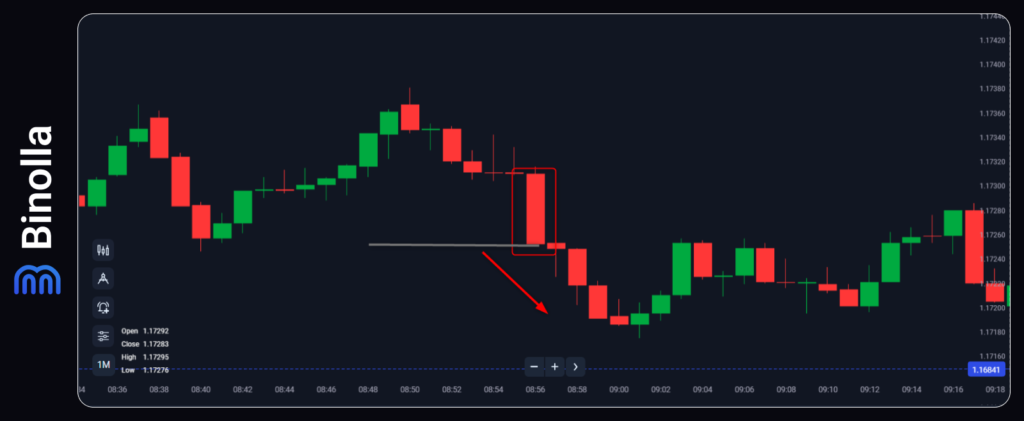
Next comes the bearish marubozu strategy that you can apply during the downtrend. To start trading it, you should first look at the candle, which should be red and long enough with no wicks or a small shadow at its upper part. Once you identify such a candle and it closes, you can buy a Lower contract. Wait for the expiration after you place an order.
Those who trade CFDs can do the same. However, they should also protect themselves from higher risks. Placing a stop loss order would be a great idea. Such an order should be placed according to your risk-to-reward rules, as placing it above a marubozu can cost you too much if you are wrong.
When it comes to targets, there are no clear goals for this exact pattern. Therefore, the best way is to wait for a reversal signal before closing a trade.
Common Mistakes When Trading the Marubozu Pattern
Now that you know how to trade with this simple and clear pattern, it’s time to tell you what you should avoid so that you can minimize mistakes. Here are some of the most common failures that may occur when trading the marubozu pattern:
- Trying to buy contracts or CFDs in sideways markets. Marubozu can be found during strong trends, which is the best possible scenario. However, you will also see marubozu in sideways markets. If the latter occurs and you see that there was no previous trend, then you should avoid opening a position.
- Placing stop losses too tight or too wide. If you are placing a stop loss too close to your position, you risk being stopped by a pullback that may occur. While a Marubozu itself is a strong candle, no one guarantees that from the beginning of the next candle, the price will move in your direction. Too wide stop losses may lead to higher losses, which is also a risky move.
- Ignoring the overall trend. A bullish marubozu should be considered only if it is inside the uptrend, while a bearish one can be found in the downtrend. Sometimes you will see a green marubozu candle in a downtrend or a red one in an uptrend. If this happens, skip.
- Trading every marubozu that you spot. Keep in mind that not every marubozu is worth trading. You should check the length of the candle and alignment with the trend.
- Risking too much money when trading the pattern. Traders should never step away from their risk and money management strategies when trading marubozu. Do not exceed more than 10% in binary options and never put at risk more than 1-2% in CFDs. When it comes to risk management, always place stop losses according to your risk-to-reward system.
Best Recommendations for Trading Marubozu Candlestick
Trading with a marubozu can be profitable, but you should follow some rules to increase your chances of making money. Here are some of the key recommendations that may help you make the most of it:
- Check the following candle movement. While the classic marubozu strategy tells you to enter when the candle is closed, some traders check the upcoming candlestick direction.
- Check the closest support and resistance levels. You don’t need to use support and resistance to enter, but you can watch how many pips the price may make before the first reversal. Binary options traders can skip this rule as the number of pips is not what they need to make profit.
- Check volumes. The marubozu candle tells you that volumes are high. However, you can also use some volume indicators for confirmation and avoid false breakouts.
- Marubozu as a breakout signal. Sometimes, a marubozu can be found on support or resistance levels. This may occur when a reversal is strong, and the opposite side pushes the price higher or lower. If the breakout occurs, you will have a great opportunity.
- Trade marubozu during important data and news events. Data releases may significantly increase market volatility, which is a good opportunity.
- Calculate stop losses wisely. If you place stop losses too tight, you may find your position closed due to a sharp opposite price movement.
- Take partial profits. CFD traders can close their positions partially. When you think it is time (for instance, on support and resistance levels), you can close part of your positions. As for the rest, you can set a trailing stop.
- Choose your timeframe wisely. While the classic marubozu is traded on the hourly or even daily timeframe, scalpers and binary option traders can find and trade it even on a 1-minute scale.
- Combine it with different indicators. While you can trade marubozu all alone, you can also add indicators like RSI to trade with them. Traders can use divergence to benefit from this pattern.
Bullish vs Bearish Marubozu Comparison Table
Now, let’s compare both marubozu patterns so that you clearly understand each of them.
| Feature | Bullish Marubozu | Bearish Marubozu |
| Color | Green (or white) | Red (or black) |
| Open equals | Low | High |
| Close equals | High | Low |
| Direction | Up | Down |
| Market sentiment | Strong buying | Strong selling |
| Trade action | Buy (long) | Sell (short) |
| Stop-loss | Below the low | Above the high |
| Risk-reward target | 1:2 or 1:3 | 1:2 or 1:3 |
Marubozu vs Other Candlestick Patterns
Marubozu stands out from many other popular patterns that you may already know. By knowing and understanding the differences between these formations, you will better grasp the pattern and how you can apply it.
Marubozu vs Doji
The difference between these two patterns lies in their bodies. Marubozu has a long full body, while doji has no body at all with one or two tails depending on the type of the pattern. When you see a marubozu candle, you can expect the price to continue its movement, while doji tells you that the situation is uncertain. Not all dojis lead to market reversals, but professional traders often consider them as signs of a possible price movement direction change or a correction.
Marubozu vs Hammer, Inverted Hammer, Shooting Star, and Hanging Man
When comparing these patterns, it should be mentioned that all of them had a long wick and a small body, while a marubozu has a long body without shadows (or with a small shadow). The difference between them lies in how traders read them. While marubozu is a pure continuation pattern, hammer, inverted hammer, hanging man, and shooting stars are reversal patterns.
Marubozu and Engulfing patterns
Marubozu is a one-candle pattern, while both types of engulfings comprise two candlesticks. The second can have a long body, and even be a marubozu. If the latter occurs, then you can be more sure about the upcoming price movement. However, the best marubozu pattern appears in the middle of the trend and not on its edges.
Conclusion
The marubozu pattern is a powerful formation that is simple to recognize and signals that the bullish or bearish trends are strong. A bullish marubozu tells you that the uptrend is likely to continue and buyers are dominating the market. When it comes to a bearish marubozu pattern, it confirms that sellers are strong and they are going to dominate the market. The pattern can work even without any indicators or additional tools, and you can quickly spot it on any charts from 1 minute to 1 week.
FAQ
What is a marubozu candlestick pattern?
A marubozu pattern is a special one-candlestick formation that has no wicks. From the open to the close level, the candle confirms domination of one side. The candle should be long enough to be considered a marubozu pattern.
What does a bullish marubozu look like?
A bullish marubozu is a green long candlestick with no upper wick. However, at the bottom, there can be a small wick demonstrating that bears attempted to turn the situation but failed.
What does a bearish marubozu look like?
A bearish marubozu is a red candle with no bottom wick. However, an upper wick is possible, which shows that bulls tried to change the situation.
Where to place a stop loss when trading with the marubozu pattern?
There is no strict rule for placing a stop loss when using marubozu. However, placing it below or above the pattern can be very dangerous, as the stop loss will be too wide in this case. It is better to use your risk-to-reward strategy to protect your risks appropriately.