Oil Price Fluctuations: How You Can Make Money on Them Right Now

Oil prices have peaked recently, driven by renewed escalation in the Middle East. The market volatility offers a lot of trading opportunities for traders using different types of financial instruments. Below you will find a detailed explanation of the factors that drive oil prices as well as learn more about how to benefit from trading oil right now.
Contents
- 1 What’s Happening in the Market
- 2 Bullish Scenario: Brent May Reach $140
- 3 Start Trading Oil with Binolla Now!
- 4 Neutral Scenario for Crude Oil: Brent May Reach $85 by Mid-2027
- 5 Bearish Scenario: Demand Destruction May Put Brent Crude Oil Below $75
- 6 How to Analyze Oil Price Moves
- 7 Economic Calendar: Which Events to Watch
- 8 How to Properly Read Headlines
- 9 How to Make Money on Oil Price Fluctuations with Binolla
- 10 FAQ
What’s Happening in the Market
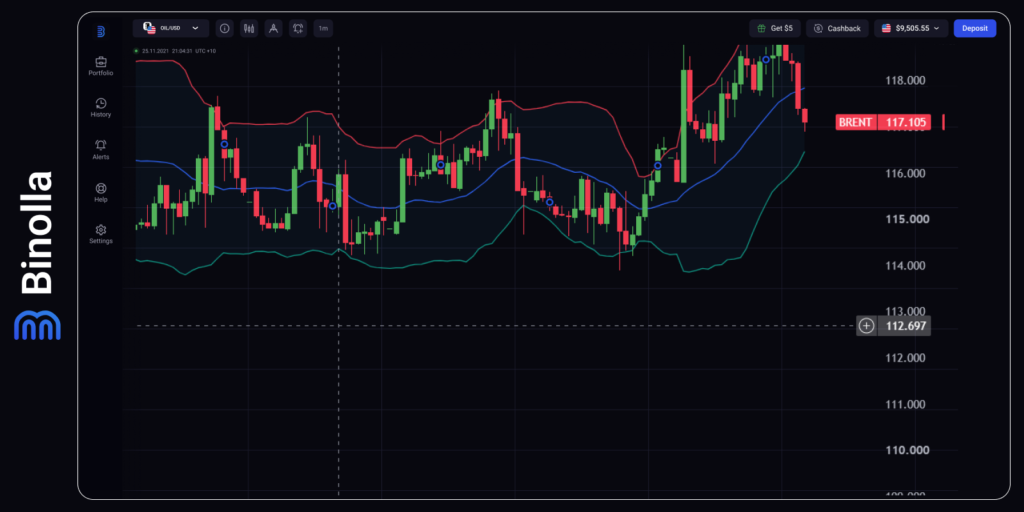
One of the main factors affecting oil prices now is geopolitical premium. Tensions in the Middle East, which result in tanker attacks in the Strait of Hormuz, Houthi strikes on oil-producing facilities, and expectations of further escalation add uncertainty. This, in turn, supports high oil prices and will be one of the key drivers for oil uptrend in the near future.
The market remains tight, but not catastrophic. According to the Energy Information Administration, production losses in the Middle East reached almost 5 million barrels per day in September. However, EIA expects that production will recover through bypass routes. Moreover, EIA mentions that global inventories are drained. Stocks fell by 507 million barrels from Feb to Aug.
When it comes to OPEC+, members decided to hold November quotas, which means that they won’t add to reserves. Actual Gulf production remains below quotas because of the conflict in the region.
On the other hand, demand is lowering as well. According to the International Energy Agency, global oil consumption may fall to 2.6 million barrels per day this year, which is the third-largest plunge in demand in history.
Now that you know the current situation in the market, it is time to look at the three scenarios that will give you insights into where the price may move in the future.
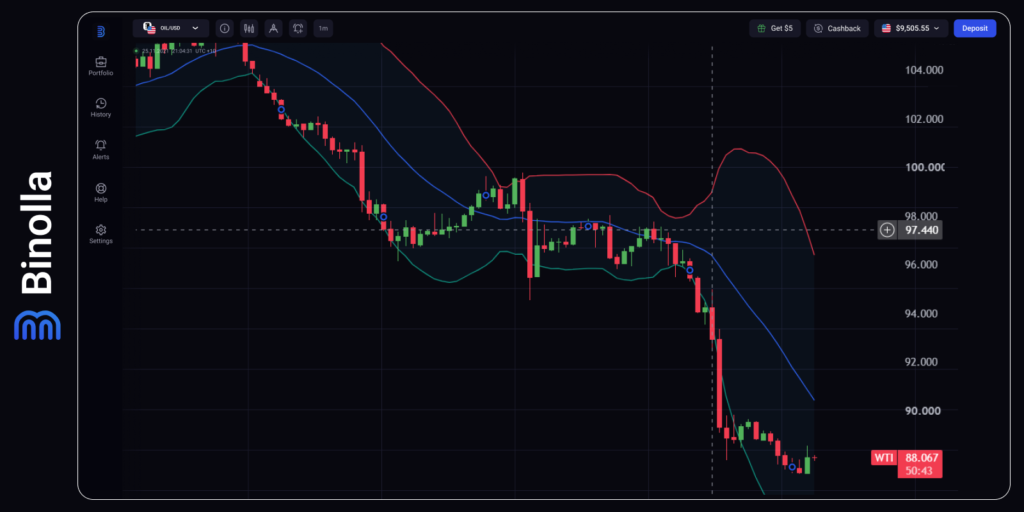
As an example, look at the chart. Current diplomatic developments in the Middle East region support de-escalation expectations. This puts pressure on the oil and wipes out the geopolitical risk premium, which, in turn, may put oil prices even lower.
Bullish Scenario: Brent May Reach $140
This scenario will develop in case the conflict in the Middle East remains unresolved. The Strait of Hormuz will remain constrained, and Gulf production will not recover before the first quarter of 2027. The scenario is backed by ANZ, which raised its year-end forecasts to $105, saying that the world is out of buffers.

Start Trading Oil with Binolla Now!
Join Binolla and benefit from oil price fluctuations with a reliable brokerage
Start nowAccording to UBS, the Brent price may stay at $110 as option markets show strong buying above $120. Both support the idea that crude oil may go even higher and reach $140. This scenario will be cancelled if a credible ceasefire with guarantees for Hormuz shipping will be reached. It is important to mention that the risk premium will vanish within days if the scenario is cancelled.
Neutral Scenario for Crude Oil: Brent May Reach $85 by Mid-2027
The conflict in the Middle East remains in its hot phase, but no escalation is seen. Production gradually returns through bypass routes. The premium compresses slowly, without sharp price movements.
This scenario is widely supported by the Energy Information Administration, which is among the most authoritative voices. According to the organization, Brent may plunge to $105 in the last quarter of 2026 and then continue its downtrend to $87 by mid-2027.
Goldman Sachs forecasts Brent crude to decline to $90 by December and continue its downtrend to $80 in 2027. According to the bank officials, while the premium remains real, it will erode gradually as production and logistics normalize.
This scenario will be cancelled if a ceasefire restores normal oil flow through the Strait of Hormuz. On the other side, a new escalation will also cancel this scenario, but oil may surge significantly in this case.
Bearish Scenario: Demand Destruction May Put Brent Crude Oil Below $75
The price shock puts pressure on demand already. According to the International Energy Agency, demand reduced to 2.6 million barrels per day in 2026. If this decline accelerates, even part of the Gulf supply will be enough to create a surplus.
The bearish scenario is backed by JP Morgan. According to the bank, Brent can reach $80 by the end of 2026 and plunge further to $64 in 2027. Analysts of the bank mention that demand evaporates and inventory draws are smaller than expected.
This scenario will be cancelled if escalation removes more supply than demand destruction removes.
How to Analyze Oil Price Moves
Oil is not a single market; to analyze its price fluctuations, you should analyze four layers with each one telling a different story. When looking at the price, you read the summary of all arguments. Here are the factors you should consider when analyzing price fluctuations:
- Physical barrel. This is the spot price and the premium or discount. When the market is healthy, differentials are stable. However, in times of turbulence, the physical market is influenced by many factors. Right now, the situation in the Middle East creates an additional risk premium as buyers are paying for barrels that can be delivered outside the region.
- Futures prices. The shape of the futures curve is the market’s term structure of fear. Backwardation means the market pays a premium for barrels now, which means that the supply is tight. Contango means the market expects relief and is willing to pay to store the commodity. This curve is among the most informative signals in the market, which brings together the views of everyone who has to take physical delivery.
- Inventories. This layer shows how much oil is stored currently. While prices can lie for weeks, inventories will tell you the truth. The weekly petroleum inventory report is among the most important data to watch that helps analyze oil price fluctuations.
- Market sentiment. This is one of the most evident factors that you should watch when trading crude oil. The crowd reacts to what it gets from news headlines. When speculative longs are at their highs, the market is crowded and vulnerable to sharp reversals on any disappointment. When sentiment is neutral or sellers dominate, there is a room for a squeeze. While the sentiment and positioning does not tell you the direction, they help you understand how much fuel is available for a movement in each direction.
Economic Calendar: Which Events to Watch
Technical analysis allows you to see the current price fluctuations and try to predict future movements based on indicators or candlestick formations. However, professional traders, especially those who hold positions for weeks and months, pay attention to various data releases and events. They include:
- EIA petroleum status data. Released on Wednesday, this reading shows inventories, utilization, and production. This is the highest impact release for the oil market. A surprise reading can result in significant price fluctuations.
- CFTC commitment of traders. This data is released on Fridays and shows speculative positioning in both oil benchmarks. Looking at this report can be useful for those looking for price drivers.
- OPEC+ meetings. These events take place monthly. The group decides the quota for the supply ceiling for the next month or longer periods. Traders should watch not only quotas themselves but also monitor members’ production. If a country produces above the quota, the quota itself means nothing.
- IEA and OPEC monthly reports. Both organizations publish supply and demand forecasts. The gap between them is a signal about consensus.
- EIA short-term outlook. This is the most detailed forecast of US and global supply and demand, including prices.
- Geopolitical events. Traders should also watch current geopolitical developments, including wars, logistic disruptions, and various incidents. Currently, financial markets are watching geopolitical tensions in the Middle East. Any further escalation may support oil prices and add a risk premium, while de-escalation may put pressure on quotes.
How to Properly Read Headlines
Most traders lose money not because they are wrong about oil. They react to headlines that are already priced in. Here are the rules that will help you read headlines properly:
- What the headline changes about physical flows. If it says about a tanker attack that damages a ship, it is a really supply event, and the price may surge. If it tells about a threat to ships, it is not a supply event, and the reaction may be different. The market reacts to real events and not to what may happen. Therefore, the news that changes the probability moves the price.
- Make sure that you know that escalation is not a confirmation. If headlines tell about a low probability of an event and then the event happens, then this may move the price significantly. If the event confirms the headlines, there is a huge probability that it was already priced in, which means that the reaction can be weak.
- Watch the second derivative. When the event happens, the price may react. However, the most profitable trades are often not those that are driven by the initial event. Those are ones that are driven by news that the physical system can route around disruption. This one has a longer effect, which allows market participants to catch longer trends.
- Never trade news you can’t verify. Rumors are always part of the game. However, in the world of oil trading, they may both favor your profits or lead to losses if you can’t verify them. If you place a trade based on unconfirmed rumors, you can lose money. If you can’t confirm a source with a verifiable claim, better avoid a trade and treat such a headline as noise.
How to Make Money on Oil Price Fluctuations with Binolla
You can trade oil using futures, options, and even CFD contracts. However, there is a way that makes oil trading even simpler and more straightforward. Binolla offers special contracts with a very simple nature, as you need to predict the direction only. How it all works?
Imagine that you expect Brent Crude to rise from the current $108. You just buy a Higher contract and set the expiration, like 1 minute, for instance. This means that if in one minute the price of crude will be at least $108.01, then you will make money.
The other case is when you expect crude oil to plunge from $108, for example. You buy a Lower contract and set the expiration, like 5 minutes, for instance. If in five minutes the price will be below $108, then you will make money.
Sounds simple? And it is. No stop losses and no take profits; you just focus on market predictions. How to buy oil with Binolla?
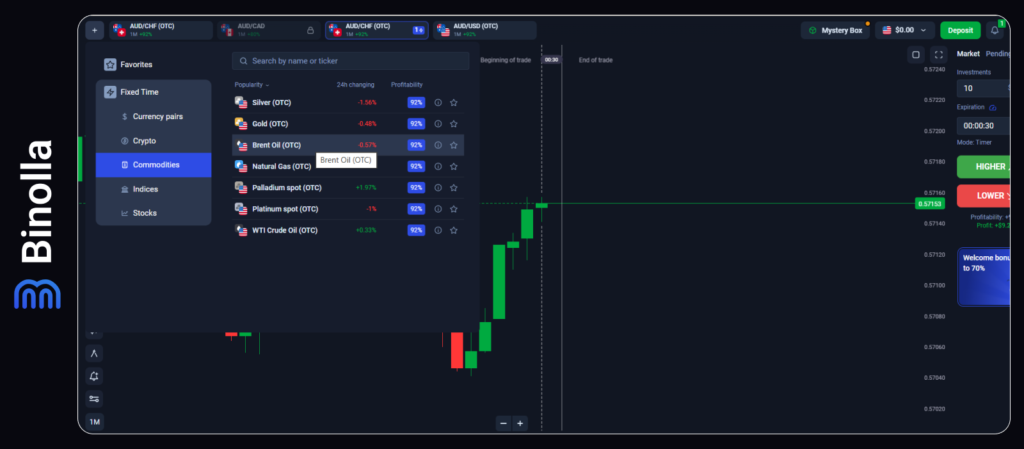
Let’s break down the whole process:
- Log in to the Binolla account and make sure you have money on your balance.
- Go to the assets tab at the top of the screen and select Commodities. Once you are there, choose Brent Oil or WTI Crude Oil.
- Now that you are on charts, make your prediction.
- Set expiration and choose the investment amount (do not invest more than 10% of your balance per trade).
- Press Higher or Lower depending on your prediction.
Now the trade is placed, and you simply need to wait for expiration to see the outcomes.
FAQ
Is it late to buy oil above $110?
If you are trading futures and options, this may be too late because all current risks are already priced in. However, if you trade oil with digital options, you can buy and sell short-term contracts and make money on short-term price fluctuations.
What is the biggest risk for the bull case?
The biggest risk for the bull case is demand destruction. According to the IEA, demand may reach 2.6 million barrels per day in 2026. If the decline accelerates, supply will become less relevant.
What happens if there is a ceasefire deal tomorrow?
The risk premium will collapse in this case, which means that Brent may lose around $27. That will be the first move. The second move will depend entirely on the physical market. If demand will remain weak, prices may reach even $80.
How can I benefit from crude oil price fluctuations?
There are many ways to trade oil and make money on their price fluctuations. You can buy CFDs, futures, and even options. However, one of the simplest ways is to participate in digital options trading, which gives you exposure to the oil market without complex money and risk management tools.