3 Scenarios on Gold (XAU/USD) Price: How to Make Money on Gold Right Now

Gold remains one of the most popular assets so far in global markets. A lot of investors and traders use it to hedge their positions or simply make money on XAU/USD fluctuations. This results in both bullish and bearish opportunities that are presented at every moment. Whatever financial instrument you use, you can benefit from gold price fluctuations. By reading further, you will learn more about the current situation in the commodities market, the main scenarios for future price fluctuations, as well as how to start trading gold right now.
Contents
Gold Market Today: XAU/USD Current Trends Overview
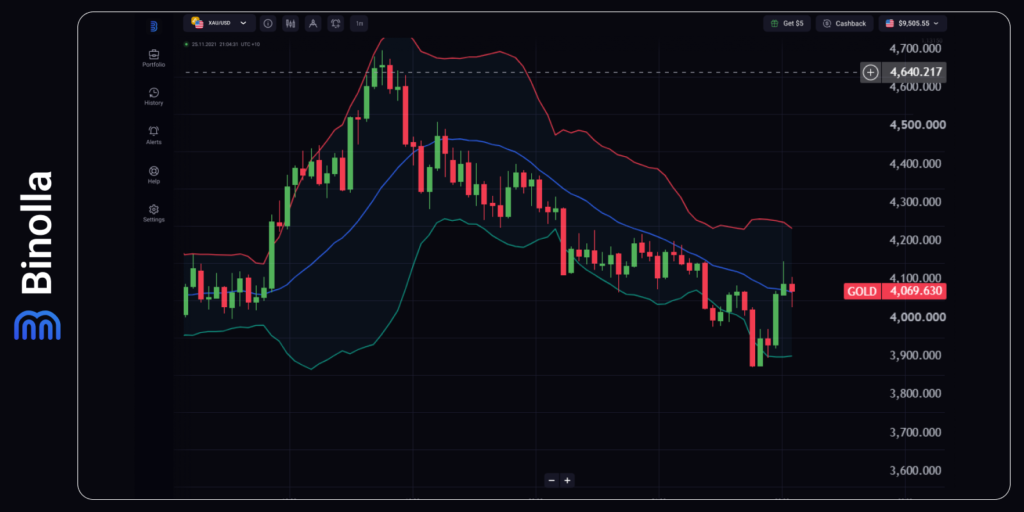
Gold prices recover from a substantial decline that lasted from the beginning of September 2026. The market remains sensitive to changes in the US monetary policy as the Fed continues its hawkish strategy with a possibility of another rate hike before the end of the year. Here are the main factors that currently affect gold prices:
- Fed policy. Gold is a non-yielding asset, which makes it sensitive to shifts in rates and real yield. When traders and investors expect higher rates, which result in higher Treasury yields and gold become less attractive even in times of economic and geopolitical turbulence (despite gold’s safe-haven status). When yields are expected to plunge, gold may recover and reach new highs.
- The US dollar. Gold is denominated in dollars, which means that a stronger dollar puts pressure on XAU/USD, while a softer US dollar helps gold to advance.
- Geopolitical uncertainty. The current situation in the Middle East increases demand for defensive assets. However, the reaction isn’t always straightforward. Moreover, higher Treasury yields put pressure on gold, which is a non-yielding asset. Therefore, in this situation, gold, instead of setting new highs, stood below 4,000 for a while.
- Central bank and investment demand. Gold is known for its attractiveness for central banks and investors. The Chinese central bank buys a lot of gold to diversify their reserves. However, even with these record purchases, gold still remains under pressure and far below its record highs.
Three Gold Price Scenarios
Rather than relying on a single forecast, traders and investors could watch three possible scenarios and stick to one if they see that the conditions are favorable. Here are three possible ways for the gold price to move in the near future.

Bullish Scenario: Gold Breaks Above 4,150
According to the bullish scenario, gold should maintain support around 4,050 and can break above 4,100 and even higher. The strongest confirmation for this scenario will come from a weaker US dollar and lower Treasury yields. This, in turn, may happen due to softer-than-expected inflation in the United States, which will allow the Fed to end its restrictive policy strategy and switch to a more accommodating stance.
The bullish scenario is supported by JP Morgan, which forecasts strong demand for gold from central banks and major investors. Standard Chartered also views bullish scenarios for gold emphasizing its long-term support from diversification and concerns about currency purchasing power.
According to Ray Dalio, founder of Bridgewater Associates, gold may break above current resistance levels due to the same reasons: diversification of assets and geopolitical uncertainty.
Neutral Scenario: Gold Stays Between 4,000 and 4,100
In this scenario, buyers and sellers remain in balance, which means that the gold will fluctuate in a range for some time without breaking the closest support and resistance levels. This scenario is a perfect opportunity for range traders who use bounce strategies, buying from support and selling from resistance.
This consolidation outlook is widely supported by Goldman Sachs. The bank has reduced its year-end targets to 4,150. However, for 2027, forecasts from the bank are more optimistic.
The reason behind this revision is simple. The bank expects that restrictive monetary policy will remain for longer, which will support the US dollar and Treasury yields.
The World Gold Council also remains neutral. They evaluate gold through a lot of factors, including interest rates, economic growth, inflation expectations, and currency movements. However, the organization does not point to any price corridor.
Bearish Scenario: Gold Plunges Below 4,050
According to the bearish scenario, gold may lose positions and break below 4,050. The next level to test will be a round number at 4,000, which is a tough obstacle for bears to overpass. However, if selling pressure intensifies close to these levels, the next target could be at 3,950 and even 3,870.
The main driver for such a serious decline can be a stronger dollar, higher inflation pressure, and rising Treasury yields. This, in turn, may push the Fed to maintain higher rates for longer, which, in turn, may stimulate an additional gold sell-off in the financial markets.
This bearish forecast is supported by some analysts at Goldman Sachs believing that tighter Fed policy presents serious downside risks for gold. According to some analysts from the bank, higher energy prices and inflation expectations will also contribute to selling pressure.
HSBC is among banks that expect to remain under pressure until the end of the year. According to analysts, gold prices may reach even 3,800, but still, they do not expect any further decline, which means that the bank expects gold to extend its volatility range rather than collapse.
What to Watch in the Economic Calendar
Like all other assets, gold is sensitive to some reports and data releases that can be found in economic calendars throughout the week and month. Here are the most important events that you should check when trading gold:
- US CPI (Consumer Price Index). The US inflation data is among the key factors influencing gold prices. Traders often follow US CPI and Core CPI data, which reflects yearly inflation. Core CPI also excludes the most volatile food and energy prices. When inflation exceeds expectations; markets expect that the FOMC is likely to hike rates or switch to restrictive policy even during the easing cycle. That, in turn, will strengthen the dollar and increase Treasury yields, pushing gold prices lower. Lower inflation creates the opposite effect. The Fed may opt for easing, which puts the US dollar down. Treasury yields also decline.
- Labor market data from the US. There are three main labor market indicators that traders watch when they trade gold: non-farm employment change, unemployment rate, and average hourly earnings. NFP shows how many new jobs were added during the previous month. The unemployment rate demonstrates the percentage of the unemployed from the total number of labor power. When it comes to average earnings, this is the dynamics of wages. Market participants evaluate all three indicators as one. If the unemployment rate is low and the number of new jobs is increasing, the situation in the labor market is healthy and requires no additional steps from the Fed, while if the number of unemployed increases and the economy adds fewer jobs, this can be a signal for the FOMC to step in and deal with weak employment. Traders often compare the released data with the effect on the US dollar and Treasury yields to make the final decision.
- FOMC meeting and decisions. This is one of the most important events that may have a direct impact on XAU/USD. When the FOMC increases rates, the US dollar gains support and Treasury yields rise. This puts pressure on gold. On the other hand, when the FOMC decides to cut rates, the US dollar plunges and Treasury yields decrease. This is a favorable situation for gold. Remember that this is a classic situation. Market price in rate cuts and hikes in advance in most cases. This means that when the first signal for the future hike appears even before the meeting, gold will react to it similarly to other assets. And vice versa. If markets expect the FOMC to cut rates during the upcoming meeting, the reaction will come immediately without waiting for the next meeting. Also, market participants pay attention to FOMC economic projections and comments from voting members that may shed light on future decisions and monetary policy trajectory.
- Core PCE, PPI, and ISM Reports. Core PCE is a very important inflation gauge that is monitored by the Fed. An unexpected increase may support expectations of higher rates, while if PCE decreases surprisingly, this may stimulate expectations of a more accommodative policy. Producer Price Index, in turn, demonstrates producer inflation and is also widely used by the Fed to evaluate inflation expectations. ISM Manufacturing and Services PMI shows the situation in both sectors. Weak business activity will make the Fed support the economic growth by cutting rates, while stronger economic activity may conversely prevent the Fed from switching to accommodative policy.
How to Start Trading Gold Right Now
There are several ways to trade gold, and Binolla offers simple and straightforward contracts that allow you to buy and sell the precious metal without any additional noise or requirements. With these contracts, you simply buy if you expect the price to move higher or sell if you think that gold will plunge. Moreover, you can make money on minor price fluctuations without thinking about spreads and other costs that may negatively impact your eventual profits when you trade CFDs.
So, all you need to do is to predict the price movement direction. If you see that gold may move upside in the upcoming minutes, then you simply press the buy button and wait for the expiration of the contract. Those who expect gold to plunge press sell and wait for expiration. No stop losses or take profits, no risk-to-reward ratio calculations. Only pure market analysis.
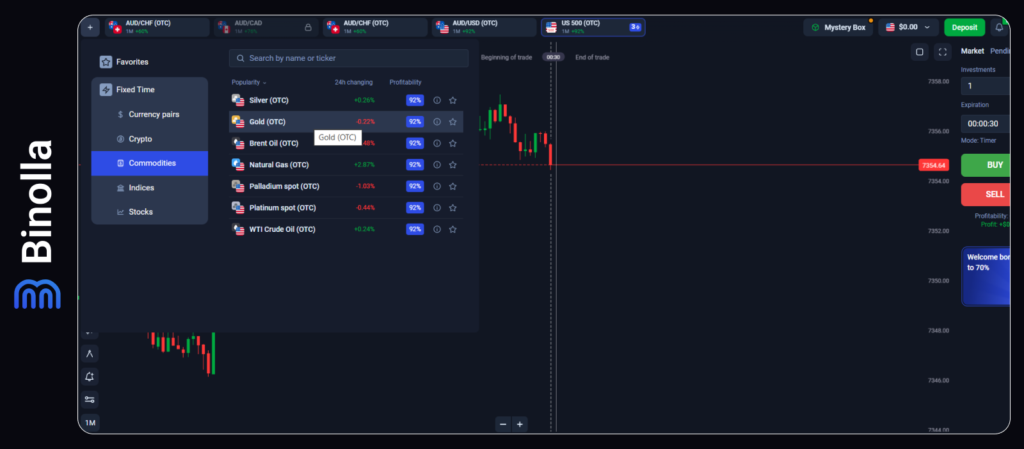
To buy or sell gold on the Binolla, you should complete several simple steps. Let’s break down the whole process:
- Log in to the Binolla account and make sure you have money on your balance.
- Go to the assets tab at the top of the screen and select Commodities. Once you are there, choose Gold.
- Now that you are on charts, make your prediction.
- Set expiration and choose the investment amount (do not invest more than 10% of your balance per trade).
- Press Buy or Sell depending on your prediction.
Now the trade is placed, and you simply need to wait for expiration to see the outcomes.
FAQ
Can you make money when gold prices fall?
Yes, sure. To do that, you can just sell gold at Binolla to speculate on declining prices. If you expect the precious metal to plunge, simply set the investment amount, choose your expiration, and press the Sell button.
What is the best time to trade gold?
Gold experiences significant volatility during the overlap between European and American sessions. Therefore, you may have a lot of trading opportunities in this period.
Does a stronger US dollar always push gold lower?
No, not at all. While gold and the US dollar may move inversely, this correlation may break under certain geopolitical and economic conditions.
What are the most important economic reports for gold trading?
The most important reports include Fed decisions and inflation and labor market data, including PCE.
How to predict gold price fluctuations?
There is no unique way to predict prices. You can use technical analysis or major events to improve your chances. However, never forget about proper money management to protect your balance.