How to Work with an Economic Calendar: A Beginner’s Playbook
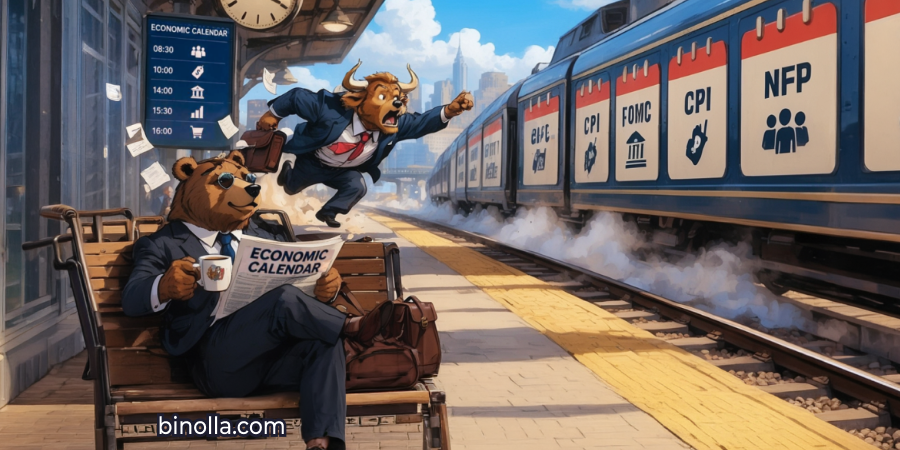
Economic calendars are important tools used by professional traders to predict price fluctuations on various markets. Whether you trade binary options or Forex CFDs, this tool is a must-have for your daily trading routine. However, trading with the economic calendar requires some basic knowledge and understanding. By reading further, you will know the basics of economic calendars and how to apply them in a correct way for your trading strategies.
Contents
- 1 What the Economic Calendar Actually Is
- 2 The Sunday Routine: Building Your Watchlist
- 3 Use the economic calendar with Binolla
- 4 The Daily Routine: Five Minutes Each Morning
- 5 How to Read the Numbers: Forecast vs. Actual
- 6 The Main News Trading Strategy for Binary Options and CFD Traders
- 7 Risk Management Around News Events
- 8 The Most Important Events By Currencies
- 9 Conclusion
- 10 FAQ
- 10.1 What is an economic calendar?
- 10.2 Which events on the economic calendar matter most?
- 10.3 Should I trade during high-impact events?
- 10.4 How do I know if a data release will move the market?
- 10.5 What does “buy the rumor, sell the news” mean?
- 10.6 How far in advance should I plan my trades around the calendar?
- 10.7 What’s the safest way for a beginner to handle news events?
What the Economic Calendar Actually Is
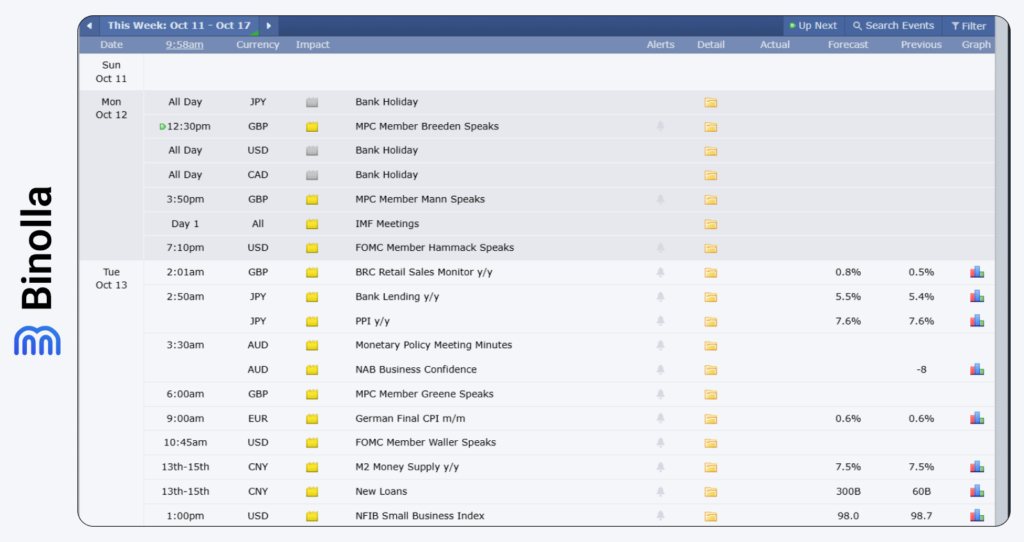
An economic calendar is a schedule of upcoming news releases and events that can affect price fluctuations on various markets. This is a kind of weather forecast, but instead of rain or snow, it shows how volatility may behave. It won’t tell you the exact direction of the price movement. Instead, it can give you a useful insight about whether the volatility may increase during some important events.
Each major economic calendar has the following points:
- Time and data of the future release
- The country affected (or the currency)
- The importance level of the event (from low to high)
- The previous reading.
- The forecast, which is what analysts expect to happen
- The final reading, which appears once the data is published
The last column is very important, as the number in it will affect price fluctuations. However, most of the action revolves around previous reading and forecasts. One of the most important things that you should keep in mind is that you should not just read the numbers. When dealing with news trading, you trade a surprise. Therefore, you should watch the dynamics between the forecast, the previous reading, and the current reading. We will explain this a bit later in this article, but first, it is time to see how to build a robust trading routine when using an economic calendar.
The Sunday Routine: Building Your Watchlist
Most novice traders begin their trading routine right at the moment when they open charts. Even if they take a look in an economic calendar, they do it occasionally, which is the biggest mistake! If you open the calendar on Monday or Wednesday and see a lot of events, you may start panicking. Below, you can find a guide on how to start working with this tool on Sunday:
- Filter currency pairs or assets that you actually trade. The first step is to see which assets you trade the most frequently. If it is EUR/USD or GBP/USD, then you can just leave them alone and check only those events that influence those currencies. Everything from JPY to CAD is the noise for you. Leave just EUR, GBP, and USD.
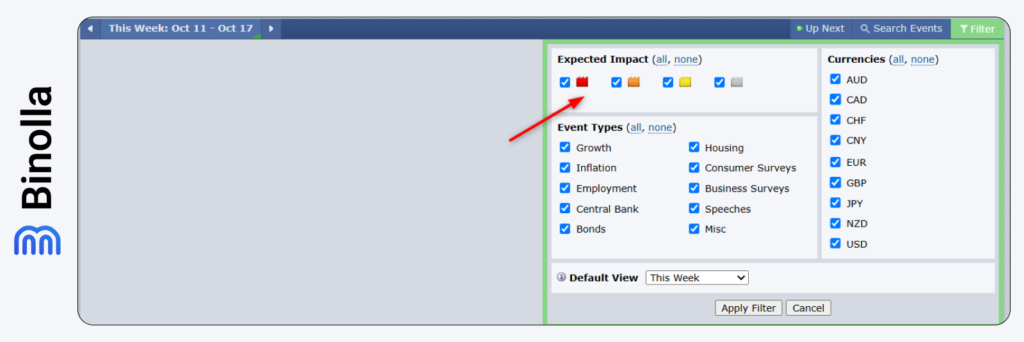
- Filter by impact. All economic calendars allow you to filter events by their expected impact. News traders often choose those events with the highest impact (red square in the Forexfactory caneldar). Also, you can leave the orange square as well, as those are events of medium impact, but under some conditions, they may also give higher volatility.
- Identify the most important events for the upcoming week. Once you filter out currencies and impact, you can browse through the calendar and mark events that you are going to trade during the week. Also, you should read about those events and what you can expect when the news is released. The most important events include interest rates, central bank meeting minutes, inflation, and labor market data.
- Write down your own schedule. Now that you have prepared your own calendar, you can create a spreadsheet and write down all the events that you are going to trade. Add there date and time, day of the week, as well as the name of the event, current reading, and forecasts. This will be your plan for the upcoming week. When you wake up on Monday, you will know in advance which events you are going to trade and how they can affect price fluctuations.

The Daily Routine: Five Minutes Each Morning
On Sunday you create your weekly schedule, which will be your roadmap for the upcoming week. Now, you should also spend some five minutes each morning to check which events can be traded during the day. To do that, you should open your calendar and simply filter today. Then you should watch your wishlist and check which events you are going to trade today.
Then check the forecast against the previous reading. For instance, if you are going to trade the US CPI, which is scheduled today, you might see the previous reading, which is 3.1%, and a forecast of 3.0% (these are fictional figures, as they are given just to let you see how it works). You may expect that if the inflation is lower, then the dollar may lose ground. If the actual will be 3.4%, for instance, then the dollar may strengthen. If the final reading comes below forecasts, the downside is possible.
Next, check when the event will be released. How long until the release? If you still have hours before the event, you can trade normally. However, you should prepare for trading within the hour. The volatility may decrease before the event, and the range may become even tighter.
Now that all the preparations are almost done, you need to set a reminder for fifteen minutes before the release. This will be your cue to close your previous trades or to prepare yourself for trading during the news release.
How to Read the Numbers: Forecast vs. Actual
Now that you know how to prepare yourself for news trading, it is time to delve into how to read the numbers and what actual and forecast mean. So, if you look through a calendar and see for instance, US non-farm employment release, you will see the following:
- Previous: 180K jobs added last month
- Forecast: 100K jobs are expected to be added this month.
So, you see that the forecast is lower than the previous reading. This means that analysts expect the job market to cool. Now, if the actual number comes out at 250K, for instance, this will be a massive beat. The economy added a lot more jobs than anyone expected. For this US dollar, this will be a bullish signal, as the Fed will consider this number as a sign of better labor market conditions.
For binary option traders, the best strategy is to buy a contract right at the moment of data release. For instance, if you see that the labor market data comes better than expected, then you can just buy a Higher contract.
For CFD traders, the situation may be a lot more complex, especially if they bought an asset before the release. Therefore, it is recommended to close all short-term trades that can be affected by the news release and open them once the event is live.
Why You Shouldn’t Trade in the Final Fifteen Minutes
Some traders, especially those who do not watch the economic calendar, may open positions even before the news release. The trick is that at that time, markets can behave very unpredictably. Most of the time, volatility becomes lower at this period and ranges become tighter. This makes trading extremely uncomfortable.
Therefore, even if you are not a news trader, it is recommended to watch a calendar and mark the most important events to know when to avoid placing trades.
The Main News Trading Strategy for Binary Options and CFD Traders
There are three key strategies that binary options and CFD traders use. Let’s have a closer look at them:
- Placing a trade before the news release. This one is suitable for CFD traders and those binary traders who place 1-hour+ trades. It is based on the concept of predicting the results in advance. You use only the previous reading and the forecast. The best part is that you can open a trade with normal volatility and normal spreads. Therefore, you lower your trading costs and trade without slippages. However, this method comes with a significant disadvantage: If your forecast is wrong, then you may have a significant drawdown or even lose the entire investment.
- Placing a trade right after the news release. This strategy seems to be perfect from all sides. You just see the final result and you can expect the price to move in a specific direction. For binary option traders, it is one of the best ways to trade news, and if you are right about the direction, then you will make money. However, for CFD traders, trading costs may rise significantly. First, Spreads become wider. For instance, if the standard spread for CFD EUR/USD currency pair is 3 pips, then right after the news release, it may reach 10 pips and even higher. Second, slippage is possible. This is another negative feature of CFD trading (which is not relevant for binary option traders, by the way). You can place a buy order when EUR/USD is at 1.1200, for instance, but the trade will be executed at 1.1205.
- Catching the following movement. This is one of the safest strategies for binary options and CFD traders. You catch the movement after the initial volatility burst. Traders using this method often waits for fifteen minutes and then places trades. The benefit is evident: you skip the initial market noise and join the movement. However, there is a drawback as well. The movement may be exhausted at the moment when you join.
Risk Management Around News Events
You can’t control the outcomes of each data release. However, what you can control is what you do about it. Here are some recommendations that will help you keep your balance protected against significant trading risks:
- Reduce your position size. Whether you trade binary options or CFDs, do not invest your ordinary amount because risks are higher when you trade the news. If you invest 10% of your balance in standard situation, reduce this amount to 5%. When it comes to CFDs, do the same. When it comes to stop losses, you can places tighter ones. But remember that in this case, your stops may trigger as volatility risks.
- Avoid market orders when trading CFDs and you place a trade right after the news. In this case, you may have a significant slippage, or spreads will be higher. Place limit orders instead. Binary option traders can use their standard orders, as these contracts are not subject to spreads or slippages.
- Wait for the dust to settle. If you are trading after the news release, do not enter right away. Wait for the noise to cool and enter when you see a clear trend.
The Most Important Events By Currencies
Each economic calendar offers a lot of events and you may quickly lose yourself in this abundance of information. Below we have prepared a table with the most important events that you can follow to trade most of assets.
| Currency | Event | Frequency |
| US Dollar (USD) | Non-Farm Payrolls (NFP) | First Friday of every month |
| CPI (Consumer Price Index) | Monthly | |
| FOMC Interest Rate Decision | Eight times per year | |
| GDP | Quarterly | |
| Euro (EUR) | ECB Interest Rate Decision | Every six weeks |
| Eurozone CPI | Monthly | |
| German Ifo Business Climate | Monthly | |
| British Pound (GBP) | Bank of England Interest Rate Decision | Monthly or every six weeks |
| UK CPI | Monthly | |
| UK GDP | Monthly and quarterly | |
| Japanese Yen (JPY) | Bank of Japan Interest Rate Decision | Monthly |
| Tokyo CPI | Monthly | |
| Tankan Survey | Quarterly |
Conclusion
Using an economic calendar is much easier when you know how to do it. This tool allows you to be aware of the most important events that may influence various groups of assets. Therefore, you will have an edge, which will allow you to make right decisions and improve your trading results. However, you should remember that none of the results that you will see in such calendars guarantee that the price will move in the expected direction. Remember about risk management and use a strategy that suits your trading goals.
FAQ
What is an economic calendar?
An economic calendar is a special tool that includes upcoming economic and financial events and data releases. Such calendars show the importance level, data, and time, as well as forecasts and previous readings.
Which events on the economic calendar matter most?
Central bank decisions, inflation data, and the labor market are the most important data releases, especially US non-farm payrolls.
Should I trade during high-impact events?
If you want to catch higher volatility, you should trade during the most important data releases. For binary option traders this is one of the best strategies to benefit from large price fluctuations. CFD traders should be careful as trading costs increase in this case.
How do I know if a data release will move the market?
In most cases, final readings that are below or above forecasts lead to significant price fluctuations. However, if these readings are close to forecasts, reaction can be muted.
What does “buy the rumor, sell the news” mean?
This means that the market often moves on anticipation of an event rather than on the released data.
How far in advance should I plan my trades around the calendar?
The calendar should be reviewed each week and checked every day. This way, you will have a clear plan on when to trade if you want to catch the most important data releases.
What’s the safest way for a beginner to handle news events?
The safest way to deal with news is to choose your strategy in advance. If you trade binary options, you can open a trade right after the news is released. CFD traders should close their positions fifteen minutes before the news release and open new ones after the release or even wait until the noise cools.