Top Mistakes in Money Management Binary Options and CFD Traders Make

Binary options and CFDs can be very profitable if you know not only how to find trading signals, but also how to manage your funds properly. A so-called money management is the basis of successful trading. A lot of traders fail just because they don’t know how to calculate their per-trade risks and how to manage funds appropriately. We have already posted an article about proper money management. Now it’s time to look at some mistakes traders make every day that prevent them from trading profitably.
Contents
- 1 Mistake 1: Risking Too Much Per Trade (The “All-In” Mentality)
- 2 Mistake 2: Ignoring the Risk-to-Reward Ratio (The Illusion of Win Rate)
- 3 Mistake 3: Neglecting the Power of the Stop-Loss
- 4 Use your Money Management Strategies with Binolla!
- 5 Mistake 4: Letting Emotions Dictate Position Size (Revenge Trading)
- 6 Mistake 5: “Averaging Down” on Losing Trades
- 7 Mistake 6: Ignoring the “Cost of Trading”
- 8 Mistake 7: Lack of a Trading Plan and Inconsistent Position Sizing
- 9 Mistake 8: Withdrawing Profits Too Early and Too Often
- 10 Conclusion
- 11 FAQ
Mistake 1: Risking Too Much Per Trade (The “All-In” Mentality)
This is the number one mistake that blows accounts of both binary options and CFD traders. The temptation to double up or risk a massive percentage of your balance on a single trade that you are sure of is too high. Sometimes, traders want just to win back after a loss, and they start using the so-called Martingale just to get back the money they lost in a previous trade.
While you still can make the next trade profitable, a lot of examples of how traders lose even higher amounts show that doing this is a big mistake. For instance, if you buy a binary option contract with 50% of your entire balance, then you may lose half of your funds if the outcome of the trade is negative. The same is with CFD. If you use the maximum possible leverage and risk about 50% of your total balance, you may see your funds evaporating faster than you can even imagine.
So, what is the solution? Do not risk more than 10% in a single trade. This should be the rule number one you apply to all your trades. Also, when trading CFDs, you need to place stop losses that will limit your potential losses to 10% of your balance.
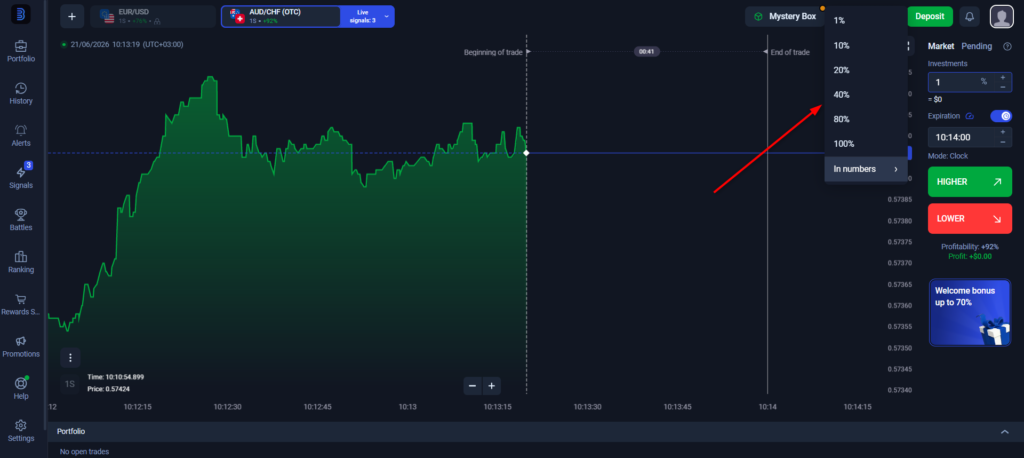
Happily, you don’t need to make any calculations with Binolla. You don’t need to calculate your trade size before every deal. You just set the investment as a percentage, and it will adjust the size of your position every time automatically. This saves time and allows you to focus on your strategy.
Mistake 2: Ignoring the Risk-to-Reward Ratio (The Illusion of Win Rate)
A lot of traders think about their win rate and forget about their risks compared to eventual rewards. This may not be a big problem if your strategy’s win rate is 80%, then you can put at risk 1 pip and expect even 0.5 pips in return, and you will still be profitable over time.
The situation changes when your win rate is 60% or even lower. For CFDs, if you risk $100 to make $50 in a trade, then a single trade may blow your balance entirely. Therefore, you should think about how to maintain a positive risk-to-reward ratio like 1:2 and even 1:3 in order to add to your balance in the long run. Keep in mind that this is important for CFDs only. In binary options, you should simply avoid trading 10% of your total balance, and if your strategy has a positive win rate like 60%, you will be successful over time.
Let’s see some calculations:
| Risk-to-Reward Ratio | Minimum Win Rate Required to Break Even |
| 1:0.5 (Risk $1 to make $0.50) | 67% |
| 1:1 (Risk $1 to make $1) | 50% |
| 1:1.5 (Risk $1 to make $1.50) | 40% |
| 1:2 (Risk $1 to make $2) | 33% |
| 1:3 (Risk $1 to make $3) | 25% |
As you can see from the table, win rate and risk-to-reward ratio are interconnected. In CFD trading, you may have even a poor strategy and have positive results. But, in reality, this is not the best solution. Better have a strategy with a 60%+ win rate so that you can feel comfortable in trading.
Mistake 3: Neglecting the Power of the Stop-Loss
One of the reasons many traders choose binary options is that the money management system in these contracts is far more straightforward. Once you place a trade, you simply wait for expiration without thinking about how to protect your risks (you can’t lose more than your investment amount).
In CFD trading, even one single trade can devastate your balance entirely! So you need to learn how to protect your position so that it won’t destroy all your previous efforts. Professionals use stop losses. There are many ways and strategies you can apply to set stop losses. Some place them just above the current resistance level when they sell and below the support level when they buy. Some put a stop loss below or above the reversal pattern. The easiest way is to calculate it according to your risk-to-reward system.
For instance, if you use the 1:3 schema, then you should place a stop loss at a distance of 10 pips to earn 30 pips. If you expect 60 pips, then you should place your stop loss at 20 pips from the current price. Very simple!

Use your Money Management Strategies with Binolla!
Join Binolla and apply your best trading practices with a reputable brokerage
Join nowMistake 4: Letting Emotions Dictate Position Size (Revenge Trading)
We have already mentioned revenge trading before in this article. Some traders try to end their losing streak with a super trade that they are sure about, using more money in a trade they can afford. A so-called revenge trading is among the key reasons why traders fail in financial markets.
Imagine a losing streak of 3 trades where you risked 10% of your entire balance ($100) and lost $30. And you see this perfect pattern like a green hammer candle at the support level that you are 100% sure will be a profitable trade. So, what would a revenge trader do in this situation? They will press Higher with at least 30-40% of their available balance to win back.
And what if the price moves down after a green hammer? You will lose even more simply because you were unable to maintain your standard money management rules. The solution here is simple. Whatever happens, stick to your rules. You will be able to overcome any losing streaks if you stick to your rules. Moreover, some traders tend to decrease the position size on the second losing trade to minimize their capital exposure until the losing streak is over.
Mistake 5: “Averaging Down” on Losing Trades
This is a very common mistake that many traders make in both binary options and CFDs. They tend to open more positions if the price goes against them. For instance, a trader bought EUR/USD at 1.1400 and then they press another buy if the price goes to 1.1380, and more, and more. In binary options, a trader may press Higher again if the candle turns red trying to catch it at a better price.
This approach can end up in significant losses as if you average down, you often react emotionally to the market instead of thinking rationally. The price may not return to the buy level and you will see losses accumulated on your balance.
What is the solution? For CFD traders, the best way is to add to positions in confirmed trends (like swing trading strategy, when you buy after another swing at the ascending trendline). For digital options traders, the best strategy is not to add on a single asset. You should better watch for signals on other assets and increase your exposure this way.
Mistake 6: Ignoring the “Cost of Trading”
This mistake is relevant for CFDs only, as in binary options, there is no cost of trading at all. You simply buy a contract and if it is profitable, you put your entire profit into your pocket. In CFDs, you should think about spreads that may eat up part of your eventual profits. Apart from this, CFD traders are also exposed to overnight fees like swaps that may also have a negative impact on their balances.
So first, before placing a trade, you should watch the current spread. If it is too high, you should better avoid placing a trade at all and wait for better conditions. To avoid higher costs, follow these rules:
- Close positions with high swaps before daily rollover;
- Consider accounts without swap fees if you are a long-term trader;
- Do not trade when important news is released, as this may increase spreads significantly if you are not trading on a fixed account;
- Look for volume discount offers from your brokerage.
Mistake 7: Lack of a Trading Plan and Inconsistent Position Sizing
Even if you know the 1-10% money management rule, you should also understand how to apply it. Position size should be adjusted wisely, and not all market participants can do it properly. For instance, if you have a losing streak, you may decide to lower your trade size, which will allow you to survive this streak and then gradually increase your balance. During the winning streak, you may alternatively increase your position size up to 10% to make more money when you are confident.
Anyway, you should create a trading plan where you will describe your money management rules and follow them strictly. It is important to add the cases when you will decrease or increase your position size and by which amount you will change your trading volume.
Mistake 8: Withdrawing Profits Too Early and Too Often
Finally, traders often mismanage their profits by simply withdrawing funds too early. By doing that, they do not allow their balances to grow and, thus, they do not let their balance grow. They remain on the same level and can’t move to a higher one.
If you started with $100 and made $40, you decide to withdraw your profit and you are still trading with $100. Therefore, if your trade amount is 10%, then you still trade with $10. However, if you accumulate profits on your balance and reinvest them, at some point, you will reach $1,000, and your 10% trade will be $100 instead of $10, which, in turn, will increase your future profits as well. Remember that smart reinvesting will allow you to become a professional trader and make even more money.
Conclusion
Money management is among the key rules that every successful trader follows. Trading is not a sprint run; it is a marathon where only those who follow their rules and use consistent strategies win. By gradually growing your balance, you will find yourself in a situation where trading will not only pay your bills but also help you change your entire life.
FAQ
What is the single most important money management rule?
One of the most important money management rules is to avoid risking more than 10% in a single trade. This ensures you can last longer and survive devastating losing streaks.
Can I trade profitably with a small account?
Yes, sure, profitability in trading does not depend on the size of your trading account. The only thing that is important is that you follow your strategy rules and trade according to your money management system. However, there is a psychological trap. Traders with smaller balances break money management rules more frequently as they want to make more money from scratch.
What’s the difference between a stop-loss and a take-profit?
A stop loss is an order that triggers when the price moves against your position for a set number of pips. It is placed to protect your trade from excessive risks. Stop losses are used in CFD trading, and they are not applied to binary options. Take profits are orders that trigger when the price moves in your direction for a set number of pips. They are used to protect your profits from opposite price movements.
What is the Martingale strategy, and why is it dangerous?
Martingale is a strategy that requires doubling up the position size after each loss. By doing this, you will cover all your losses at the end of the losing streak and will be able to profit. However, Martingale is ideal for non-limited deposits. The streak may be long enough and you will end up losing more money without being able to continue the streak.
How do trading costs affect my profitability?
Trading costs like spreads and fees negatively affect your balance. They are not applied to binary options and can be found in CFD trading only. To mitigate their impact, look for Islamic trading accounts (swap-free) and find assets with lower spreads and higher liquidity.