How to Spot a Trend Reversal Before It Happens: The Head and Shoulders Pattern Explained

Professional traders often use various patterns to predict future trend reversals. Head and shoulders is among the most sophisticated ones, yet it is also one of the most reliable patterns so far. By mastering it, you will be able to spot reversals in advance and improve your trading performance in both binary option trading and CFDs. In this article, we’ll delve into head and shoulders and inverted head and shoulders to show you how this pattern works and how to use it in trading.
Contents
- 1 Head and Shoulders Basics
- 2 The Inverse Head and Shoulders Pattern Basics
- 3 Psychology Behind the Head and Shoulders and Inverse Head and Shoulders Patterns
- 4 Use the pattern in trading with Binolla!
- 5 Volume Analysis
- 6 Head and Shoulder Trading Strategy
- 7 Inverse Head and Shoulder Strategy
- 8 Common Mistakes When Trading Head and Shoulders
- 9 Conclusion
- 10 FAQ
- 10.1 What is the difference between head and shoulders and inverse head and shoulders?
- 10.2 How can I tell that the head and shoulders pattern is forming?
- 10.3 Do both patterns have the same rules?
- 10.4 Which pattern is more reliable?
- 10.5 How does volume behave in the head and shoulders pattern?
- 10.6 Can I trade this pattern on lower timeframes?
Head and Shoulders Basics
The head and shoulders pattern is a complex formation that appears after a strong uptrend. It shows up in the form of three peaks, with the middle one being the highest. This one is known as “head”. Peaks on the left and right are lower. The pattern can be described in the following way.
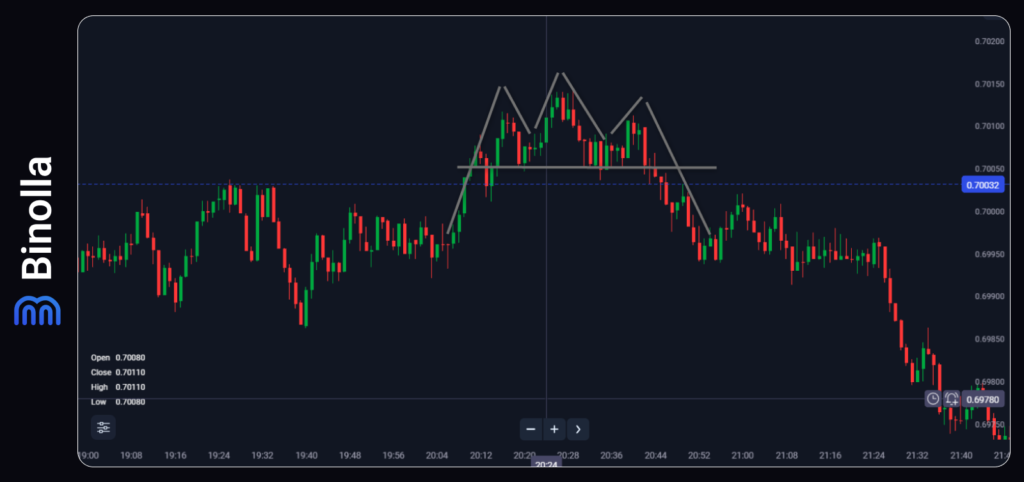
Buyers push the price higher, forming the first peak. It is still the uptrend as the price makes a higher high and a higher low. Then another peak, which is higher than the previous, confirms the bullish pressure as the price continues to set new highs and higher lows.
However, with the next peak, the situation drastically changes. Instead of making another higher high and higher low, the price makes a lower peak, which means that the bullish pressure is evaporating gradually. This is at this moment when a trader can suggest that the reversal is coming.
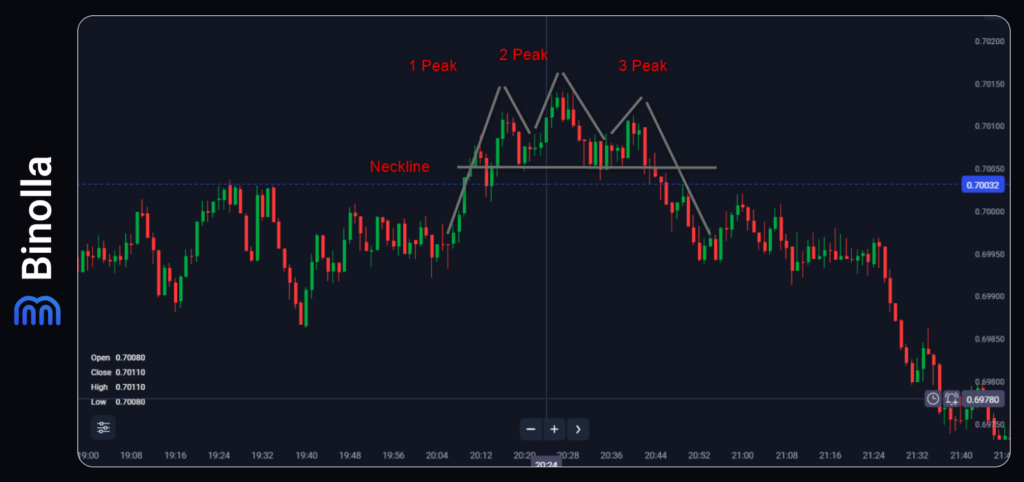
Now let’s see the break down the anatomy of this pattern. With the first peak, we see that bulls are still strong. They tend to push the price higher with new volumes and long positions in the market. When the second peak appears, bulls are still in control of the market. When the pattern is forming and you still don’t see the net price movement, it looks like the continuation of the uptrend.
However, with the next lower peak, which is known as the right shoulder, you can see that the bullish pressure is fading. At this moment, bears increase their positions while bulls still try to regain their domination.
The important part of the pattern is the neckline. This is a support level that goes through the lowest points of both left and right peaks. Later, you will see why the meckline is very important for this pattern. For now, you should just be able to connect these lowest points.
The Inverse Head and Shoulders Pattern Basics
Along with a standard head and shoulders pattern, traders sometimes find its inverse version. It appears after a downtrend, with the first peak confirming that the sellers’ pressure is still strong. They tend to push the price even lower and manage to form the next downside peak. The picture still looks very bearish as the downtrend continues.
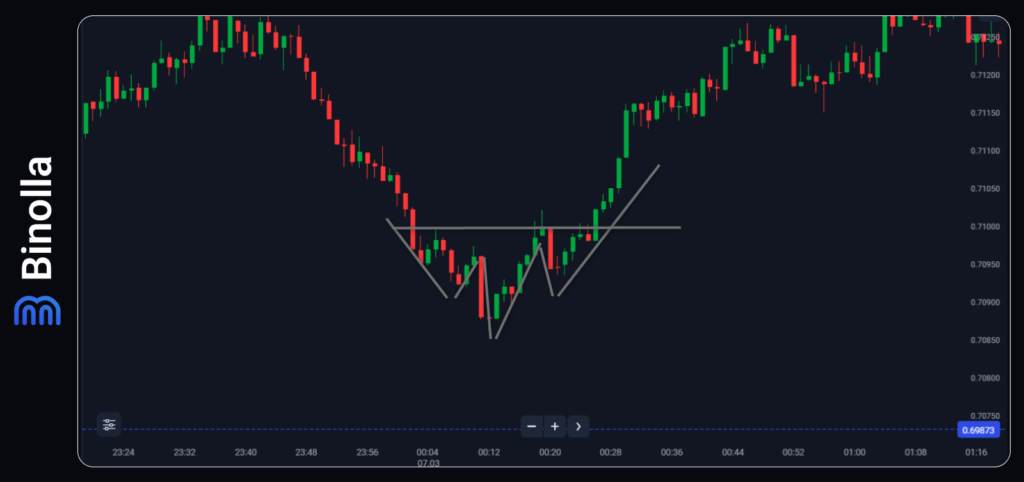
However, with the third peak, everything changes, and you can already expect the reversal. The price sets a higher high and a higher low, which means that the trend is changing. As you can see, similar to a standard head and shoulders, we have a neckline here, which is, by the way, the resistance level this time. It connects the highest points of the two peaks and will be helpful later when we are going to describe the strategy to trade with the head and shoulders pattern.
Psychology Behind the Head and Shoulders and Inverse Head and Shoulders Patterns
First, we are going to consider a standard head and shoulders pattern and how markets perceive it. Both formations reflect the battle between buyers and sellers. In a standard pattern, when the left shoulder is formed, markets are still optimistic. However, early profit-takers already emerge. Regardless of this, buyers still push the price higher to form the head.

Use the pattern in trading with Binolla!
Join Binolla and trade with head and shoulders with a reliable brokerage
Join nowLatecomers still expect the uptrend to develop and buy close to the head’s peak. This is a standard situation when market participants try to get into the market driven by FOMO. They see that the uptrend may continue and add to the general pool of long positions. However, smart money begins to evaporate. Those who bought in advance, now sell to those who want to jump into the train. This is the best description of what is going on in the market at this moment.
The volumes decrease, early buyers increase their short positions, while the number of those ready to buy plunges. After the second peak, the price makes another upside swing, but this time, buyers are unable to push the price higher. The peak is lower than that in the middle of the formation, telling that the market situation has already changed. Bulls are already disapointed and they ten to leave the market accelerating sell-offs, which, in turn, make the whole pattern work.
When it comes to the inverse head and shoulders, the situation is the opposite. Sellers push the price lower to form the first peak. However, early buyers begin to engage, driven by fundamentals or other factors.
The next peak is still lower, confirming the downtrend. At this moment, new sellers still come, while early sellers liquidate their positions and switch to long trades. The selling volume evaporates as late sellers can’t cover the money flow.
This is where the next higher peak comes. Known as the right shoulder, it shows that sellers gain momentum, while sellers try to get rid of the asset, adding to the bullish pressure.
Volume Analysis
To better understand how both patterns work, you should see how volume behaves during head and shoulders and inverse head and shoulders formations. Check the following table.
| Feature | Standard (Bearish) Pattern | Inverse (Bullish) Pattern |
| Left Shoulder | High volume (buying pressure) | High volume (selling pressure) |
| Head | Moderate volume (buyers weakening) | Moderate volume (sellers weakening) |
| Right Shoulder | Lowest volume (buyers exhausted) | Lowest volume (sellers exhausted) |
| Breakout | Volume spikes as price breaks below neckline | Volume spikes as price breaks above neckline |
Head and Shoulder Trading Strategy
Now that you know more about the pattern, it is time to see how to trade it. Head and shoulders is a rare beast, but you can expect a couple of them throughout the day, if you are using a minute chart.
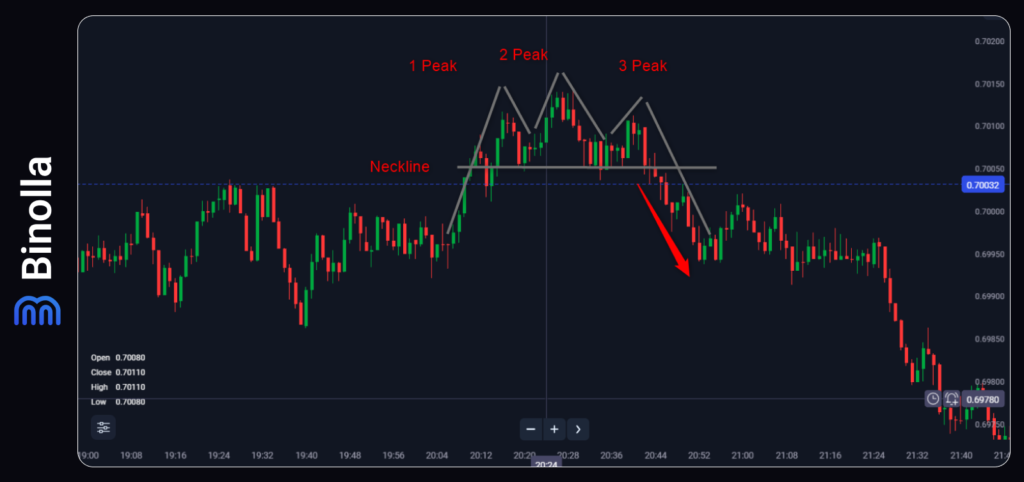
Trading this pattern is quite simple, but you should strictly follow the instructions. First, you need to make sure that you see a true head and shoulders pattern. Therefore, you should distinguish three peaks, with the middle one higher than those on both edges. By the way, left and right shoulder peaks can be equal or unequal; it doesn’t matter.
Next, you should wait for the price to reach the neckline after the third peak. At this moment, you should prepare for trading. To buy a Lower contract in binary options or to sell in CFD trading, you should wait for a clear downside breakout of the neckline. There are three ways to trade the pattern, by the way:
- You can jump into the market immediately when the neckline is broken. This is the most aggressive approach, but sometimes it remunerates traders with higher rewards. Moreover, in binary options, this can be a good solution as the breakout candle is sometimes longer than usual.
- A trade can be opened after the breakout candle closes. This is a more conservative approach, which many traders use. It allows you to be more sure about the breakout. However, you can lose part of the movement (which is, by the way, important for CFD traders only).
- Finally, there is the most conservative approach, when a trader buys a Lower contract or sells an asset after the price retests the neckline from below. While this approach may seem reasonable, you should keep in mind that such retests and not mandatory and sometimes the price moves below the neckline without any stops and swings.
Inverse Head and Shoulder Strategy
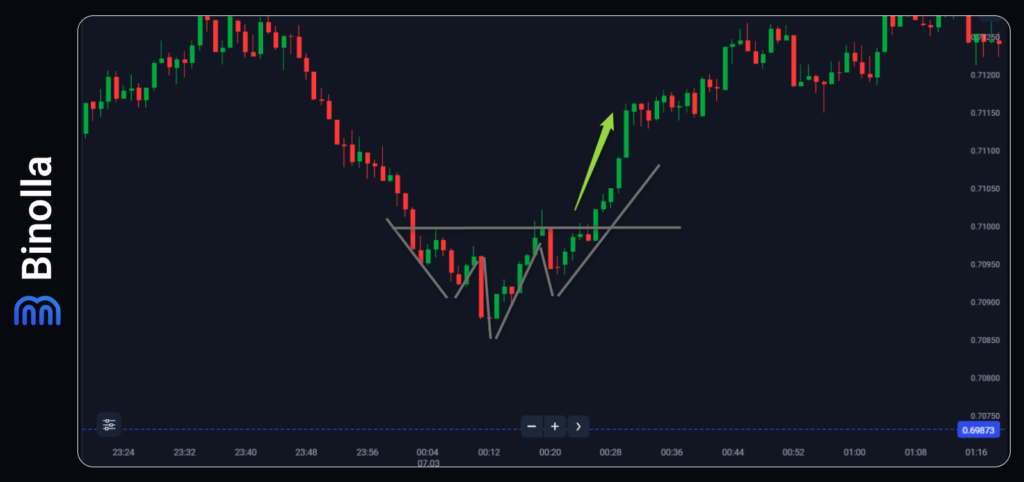
Now let’s see how to trade an inverse head and shoulders pattern. Similar to a standard one, you need to wait for the price to test the neckline after the third peak. But this time, the neckline is the resistance level, which means that the breakout will push the price higher.
To trade it, you should wait for the breakout itself to buy a Higher contract or to buy an asset when trading CFDs. Here you have three types of strategies as well:
- Some traders tend to trade agressively and they push the button right after the breakout. For binary option traders, this can be the best strategy, especially if the price makes a significant distance after the breakout. CFD traders, in turn, can make higher gains when they enter aggressively.
- The second approach is to wait for the breakout candle to close to make sure that the pattern is working. Once the candle closes, you can buy a Higher contract or purchase the asset.
- Finally, you can wait for the retest of the neckline, if it occurs. However, similar to head and shoulders, you should keep in mind that the retest may not happen at all. Therefore, if you use such a conservative approach, you may miss the opportunity.
Common Mistakes When Trading Head and Shoulders
Trading with the head and shoulders and inverse head and shoulders can really be profitable. However, you should avoid some common mistakes to improve your performance. Find out more about them and how to avoid such failures:
- Forcing the pattern. Many traders take any three swings for a head and shoulders. This leads to mistakes in trading. Not all swings can be considered as head and shoulders. Watch the pattern structure first and then apply it to the pattern you want to trade. If something misses, then better avoid placing a trade.
- Ignoring major trends. When trading CFDs, you should check the major trend in order not to be trapped with a short-term correction. This mistake is not vital for binary options traders, as in order to profit, you need only one or two candles to close in your direction.
- Premature entries. Entering the trade when the third swing forms is not the best idea. Wait at least for a breakout to jump into the market.
- Misidentifying the neckline. When trading both patterns, you should be able to clearly identify the neckline, which will give you a clear entry signal. If you fail to do that, you are likely to end up with losses.
Conclusion
The head and shoulders pattern is a great tool allowing traders to spot reversals in advance. You can use it in trading even without technical indicators, which makes it an independent instrument. When trading it, you should make sure that you have strict money and risk management rules and discipline to follow them. While the pattern is rare, it is strong and you can expect a high percentage of profitable trades if you spot it correctly.
FAQ
What is the difference between head and shoulders and inverse head and shoulders?
The difference between them lies in the nature of each pattern. Head and shoulders appears after the uptrend, and it signals a reversal down with three highs, while inverse head and shoulders forms at the end of the downtrend.
How can I tell that the head and shoulders pattern is forming?
To be able to identify the head and shoulders pattern, you should look for the following cues. First, a new higher high and higher low appear, then another peak, which is even higher. Finally, there is a lower peak, which signals that buyers lose momentum.
Do both patterns have the same rules?
Yes, both of them are identical, just flipped. When it comes to the standard head and shoulders pattern, you look for the support level breakout, while when trading an inverse head and shoulders, you look for a breakout of the resistance level.
Which pattern is more reliable?
Both of them, head and shoulders and inverse head and shoulders, are equally reliable, but they are traded in opposite market conditions. In general, head and shoulders demonstrate quite a decent level of reliability.
How does volume behave in the head and shoulders pattern?
When the pattern forms, the volume is normally high, but it dries up during the left shoulder. However, once the breakout occurs (the price breaks below the neckline), the volume rises again.
Can I trade this pattern on lower timeframes?
Yes, you can trade this pattern on all timeframes with no exclusion. This is why head and shoulders can be traded by those who prefer CFDs and binary options.