Binary Options Consolidation Breakout: How to Trade Range and Breakout Phases in Short-Term Markets

The binary options consolidation breakout concept can significantly improve traders’ results in short-term markets. By using it, you can increase the quality of your trading signals. Professional market participants use this concept along with other strategies, as strong one-sided price moves occur frequently after periods of tight consolidation. By reading this article, you will learn more about binary options consolidation breakout and how to apply it in your trading sessions.
Looking for a reliable brokerage? Join Binolla now and start trading on a reliable platform!
Contents
- 1 What Is Consolidation in Binary Options
- 2 Reasons Behind Consolidation
- 3 Start trading binary options consolidation!
- 4 Trading Breakouts After Consolidation Periods
- 5 Breakout Execution: Aggressive vs. Conservative Approach
- 6 False Breakouts and Market Traps
- 7 Trading Within Consolidation
- 8 Common Traders’ Mistakes in Binary Options Consolidation Breakout Trading
- 9 Conclusion
- 10 FAQ
- 10.1 What is consolidation in binary options trading?
- 10.2 How to identify a breakout after consolidation?
- 10.3 What is the difference between consolidation and breakout?
- 10.4 Should I trade during consolidation?
- 10.5 How can false breakouts affect my trading results?
- 10.6 When is the breakout the most powerful?
What Is Consolidation in Binary Options
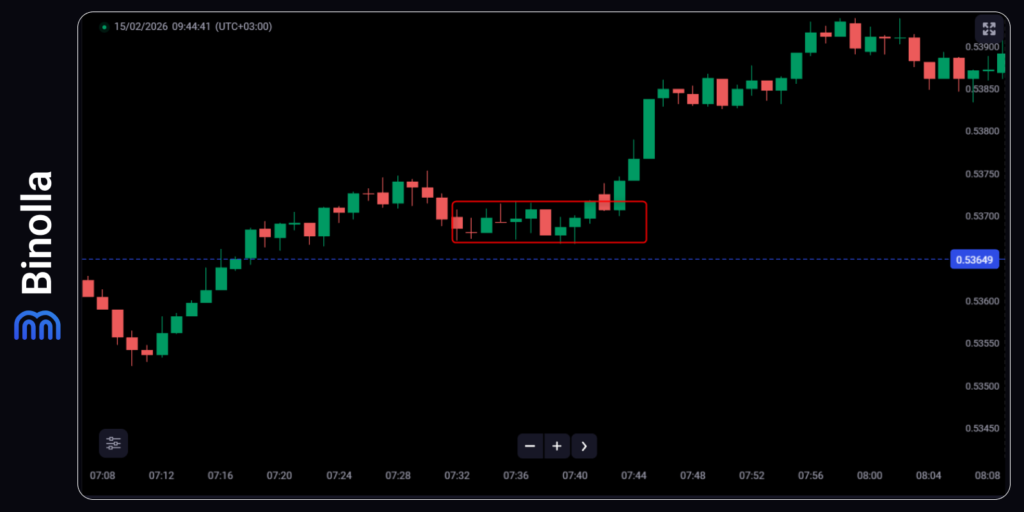
Consolidation describes a market phase where the price fluctuates between the support and resistance levels without making higher highs or lower lows. During this stage, traders can’t identify clear trend movements, which means that the market is balanced. If you look at candle charts, you will see that during consolidation, candlesticks are smaller than usual as momentum is reduced.
Consolidation appears as volatility tightens, and neither bulls nor bears can push the price to form a strong movement. It is to mention that during consolidation, both sides add to their positions, and orders accumulate near key levels. It is important to understand how to trade consolidation in binary options, as after the price breaks beyond the range, a strong movement may occur.
Binary options trading during the consolidation phase is not recommended due to the narrow nature of such ranges. The price may reverse several times, which creates risks of failure even if you have a good strategy. A profitable trade may turn into a losing one as the market oscillates within two narrow lines. One of the biggest mistakes that many beginners make is buying contracts in the middle of such narrow ranges. Trading within consolidation is not recommended, but it helps find signals later, when the price goes beyond its boundaries.
Reasons Behind Consolidation
In sideways market binary options trading, the price moves between support and resistance levels. The quotes rebound from both lines and stay within the rectangle. Any break attempts fall quickly. Consolidations often occur when there are now important news release or prior to some important event. During this period, both buyers and sellers add to their positions, but the price fluctuations are still narrow. After the event occurs, the balance changes, and a breakout occurs.
Imagine that an important CPI release takes place. Buyers of the US dollar expect the inflation to accelerate, while sellers predict some slowdown. Therefore, buyers place buy orders, while sellers go short. In this situation, when the volumes are balanced, the price will move within a tight range. Supply and demand are equal. However, once the news is released, the situation changes drastically, and you need to understand binary options range trading vs breakout logic to improve your trading results.
Once the CPI data is released, market participants change their minds accordingly. For instance, if the inflation data shows some acceleration, then dollar bulls hold their positions and even add up, while sellers leave the market or join the bulls. In this situation, market sentiment shifts towards buyers, which pushes the price higher.
On the other hand, if inflation data is worse than expected, meaning that the US dollar may weaken, then sellers add to their positions, while buyers either close their positions or join sellers, adding volumes. The price ends up moving lower.

Start trading binary options consolidation!
Join Binolla now and trade binary options consolidation breakouts with a reliable brokerage!
Join NowTrading Breakouts After Consolidation Periods
The main strategy that you can use in this situation is to find a binary options range breakout setup. Normally, it begins long before the breakout occurs, when the range becomes even narrower. This compression often signals that the market is preparing for expansion. If you understand how to identify consolidation before a breakout in binary options, then you will have a clear advantage. But even if you don’t, you can still use this strategy.
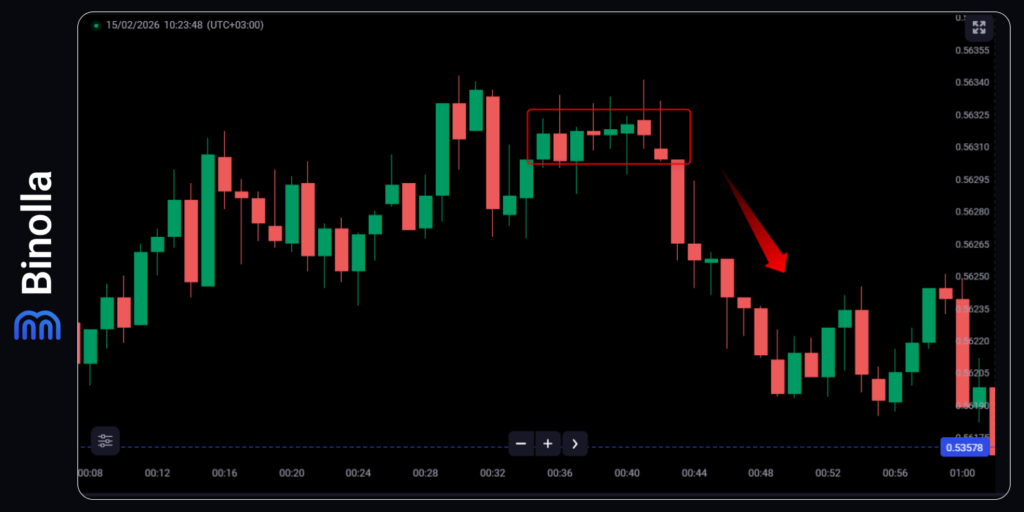
So, to trade with this strategy, you need to find consolidation first. In our example, the price consolidates within a narrow range, trying to break out many times. You can see that candlesticks have long tails, but the price stays within a range for quite a long time.
In this situation, the best solution is to trade when the breakout occurs, and the price closes below or above the range. In our case, the price breaks below the rectangle. Thus, you can buy a Lower contract after the breakout candle closes. As you can see, momentum is strong enough, and binary options traders can make money in this situation.
If you trade CFDs, this is a great opportunity to catch major price movements, as the distance between the range lines and the distance that the price makes after a breakout is different.
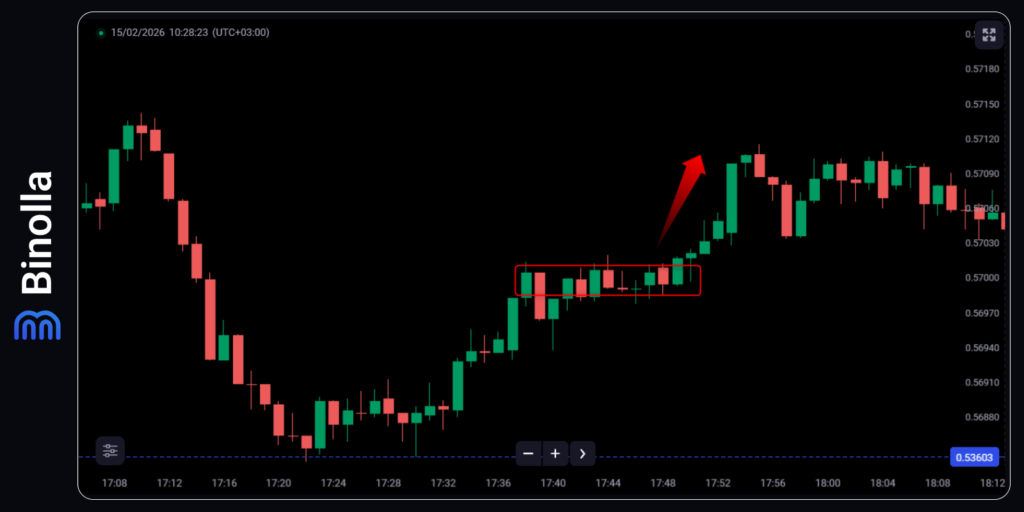
The next example shows another consolidation in a tight range, which ends with a breakout. However, this time, the price moves above the resistance level, which means that buying a Higher contract would be a great option.
To start trading, you should wait until the candle that breaks above the resistance level closes and then place a trade. As you can see, right after the breakout, the price moves higher for several candles, allowing you to profit in such a situation.
Breakout Execution: Aggressive vs. Conservative Approach
Breakout trading binary options short-term requires precise timing and execution. Unlike CFDs, where you can adjust your position after the order is placed, in binary options, once a trade is placed, you wait until expiration,n and it’s over. Therefore, you should think about when to start trading in advance.
There are two ways of trading using this approach. First is to use binary options breakout confirmation. It was already described in the previous chapter. However, when applying a breakout trading binary options short-term method, one can also engage more aggressively.
This approach requires placing a trade right after a breakout occurs. For instance, if you see that the price breaks above the resistance level, then you can buy a Higher contract without waiting for the candle to close. For downside breakouts, traders can buy a Lower contract once the price moves below the support level.
While this method sometimes rewards traders, especially those trading CFDs, as they can seize more pips by entering in advance, the problem is that not all breakouts are true.
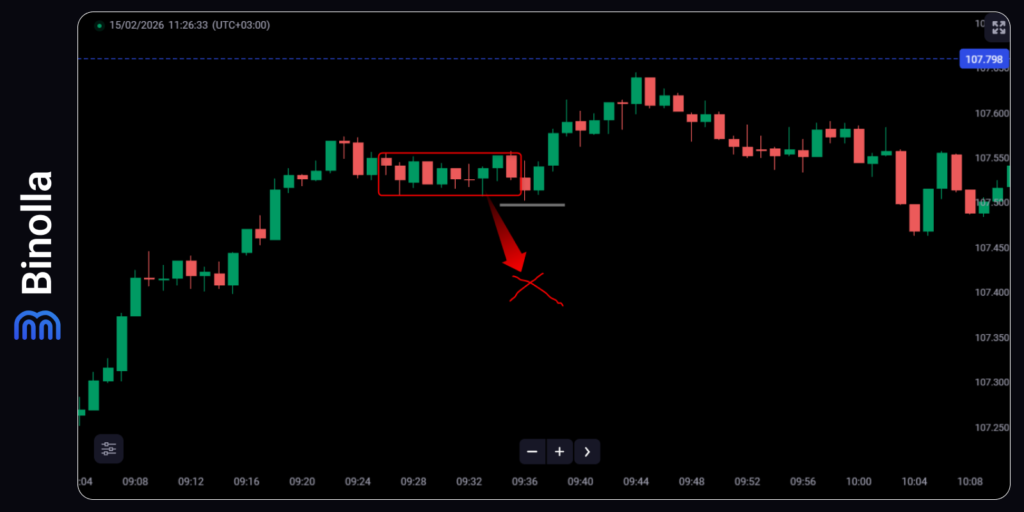
In this example, you can see that the price breaks below the support level. However, the downside movement does not develop, and then an upside breakout takes place. If you bought a Lower contract, you would lose money in this case.
False Breakouts and Market Traps
We have already covered false breakouts partially in the previous chapter. You should understand that on lower timeframes like 1 or 5 minutes, such false breakouts will occur more frequently due to market noise, which is reduced on higher timeframes. Therefore, you should be prepared to filter signals before entering a trade.
One of the most frequent market traps is when the price makes an attempt to break out and then moves within the range again. Therefore, you should be prepared for this and act accordingly. Sometimes, traders do not buy a binary option or open CFD positions even after a confirmation when a candlestick closes. They wait until the price moves back towards the consolidation and then engage.
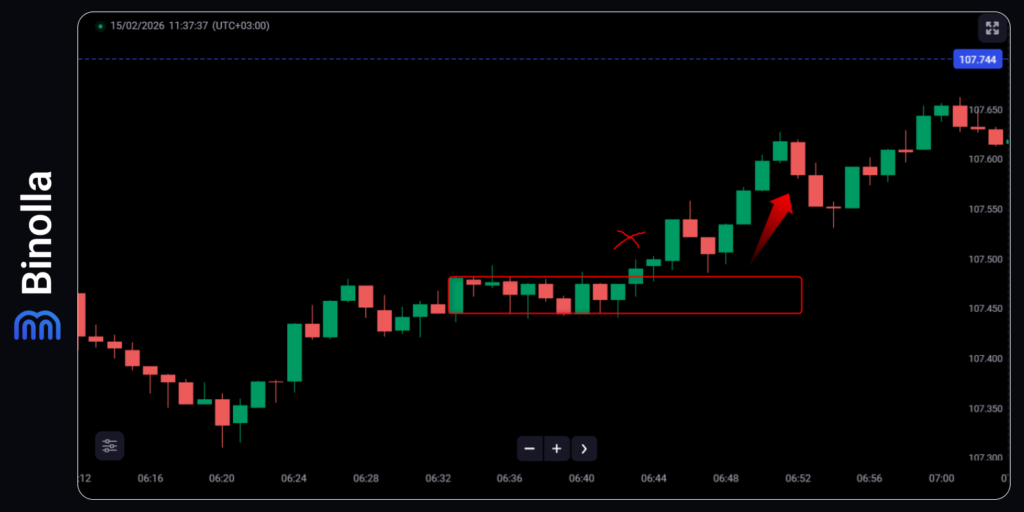
Here you can see that a breakout occurs after the green candle closes above the resistance level. When trading binary options, you can buy a Higher contract and make money. Another great opportunity is to buy a Higher contract when the price tests the resistance level and then moves higher. For CFD traders, the best option under such conditions is to wait until the retest is over and engage after the second upside movement begins.
Trading Within Consolidation
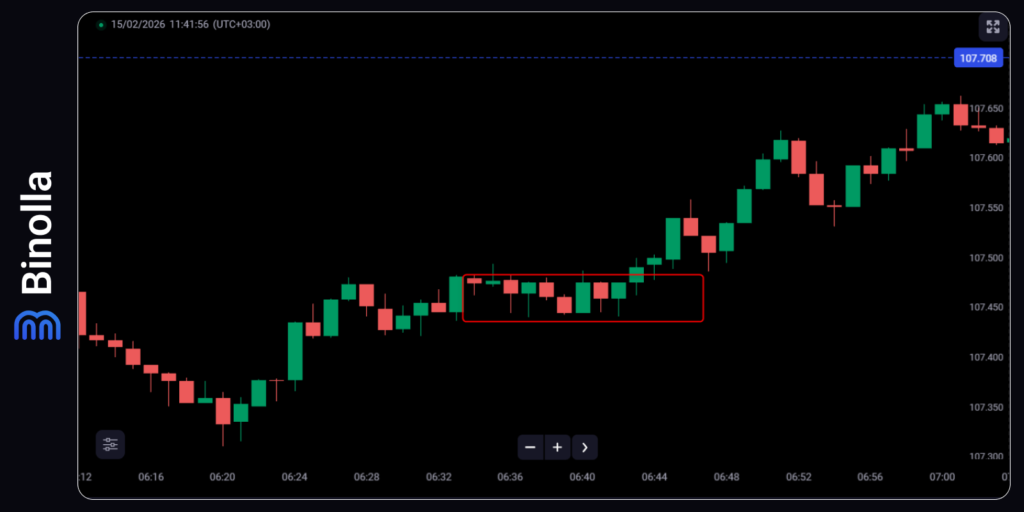
Trading within larger ranges is possible when the price makes more significant movements between support and resistance levels. However, when it comes to tight compressed consolidations, trading within them is unlikely to bring you profits. As you can see, green and red candles go after each other, which means that if you buy a contract, and it lasts for more than one candle, you will lose.
Common Traders’ Mistakes in Binary Options Consolidation Breakout Trading
Trading consolidation breakouts in binary options can be profitable. However, many traders make mistakes that prevent them from making money. Here are some of the most common pitfalls that help beginners and skilled traders improve their performance:
- Engaging too early. Entering a trade before the clear breakout may lead to losses. Therefore, make sure that the breakout is confirmed before placing a trade.
- Not being able to see the boundaries of the consolidation. Traders should identify support and resistance levels before even trading consolidation breakouts.
- Trading within the consolidation. Placing trades in times of low volatility is risky as the movements are tight.
- Using wrong expirations. Traders should set expirations according to their perception of the price movement that will follow the breakout.
- Not considering market context. Apart from simply looking at charts, traders should check trends, data releases, and other conditions that may affect price fluctuations.
- Wrong position sizes. Before entering a trade, you should know in advance how much you will invest in each trade and stick to this rule.
Conclusion
Understanding the binary option consolidation breakout method allows market participants to engage timely manner when the momentum begins. Consolidation is a preparation phase before the market will make an impulsive move in one of the directions below the support level or above the resistance line. By spotting consolidations in binary options, you can anticipate potential breakouts and make money on one-sided movements. Such a method is widely used by professional traders in both binary options and CFDs to make money even without learning price action patterns. Its simplicity attracts a lot of market participants, allowing them to improve their trading performance.
FAQ

What is consolidation in binary options trading?
Consolidation is a market phase where price fluctuated between support and resistance levels in a tight range. During consolidation, markets are in equilibrium as buyers and sellers are unable to push the price in any direction.
How to identify a breakout after consolidation?
To do that, you should first check volatility. Also, you can spot narrowing prices between support and resistance levels. Once you see that a candle goes beyond one of the levels, a breakout is taking place.
What is the difference between consolidation and breakout?
Consolidation is a phase of low volatility trading. Breakout is supported by higher volumes and price spikes.
Should I trade during consolidation?
It is not recommended to trade during consolidations as the price stays within a tight range, and it may reverse quickly.
How can false breakouts affect my trading results?
False breakouts can lead traders to negative trading outcomes, especially in binary options trading. Therefore, you should wait for confirmation before entering a trade.
When is the breakout the most powerful?
The most powerful breakout occurs after a long phase of consolidation with a small distance between support and resistance levels.