Top 6 Strategies with SMA50 That Really Work

The SMA50 is a very popular moving average used by traders for different purposes. This is a balanced view of medium-term momentum, which shows whether bulls or bears control the market. Unlike SMA200, this is less responsive to changes, SMA50 is more flexible, which allows market participants to use it in various strategies. In this article, you will learn the top 6 trading systems that digital options and CFD traders can add to improve their performance.
Ready to trade right now? Join Binolla and trade on the most reliable trading platform!
Contents
- 1 SMA50 Basics
- 2 Strategy 1: Trend Directional Trading
- 3 Start Using SMA50 Strategies!
- 4 Strategy 2: A Pullback Entry with the SMA50
- 5 Strategy 3: Trading Reversals Below and Above the SMA50
- 6 Strategy 4: Combining SMA50 and SMA100
- 7 Strategy 5: Breakouts
- 8 Strategy 6: Retest
- 9 Tips for Using SMA50 Strategies
- 10 Conclusion
- 11 FAQ
SMA50 Basics
A simple moving average is a type of moving average calculating the average price over a specific period, with the weight equally spread across the whole period. When it comes to the SMA50, it is formed by adding a 50-period moving average to the simple moving average. With each new price point, the oldest value is deducted, which means that the average follows the market.
What makes the SMA50 extremely popular among traders is that it is a balanced, simple moving average. The SMA10, for instance, reacts too quickly to price changes and does not filter the market noise, which may lead to false signals. When it comes to longer SMAs like 100 or 200, they, in turn, react slowly to short-term fluctuations and provide a smoother trend view. They are better for long-term trading, like a position trading style.
The SMA50 has both pros and cons. The main advantage is that it is simple and reliable, as it allows market participants to easily interpret the current market situation and watch whether buyers or sellers are controlling the market. On the drawback side is the standard issue of all moving averages. The SMA50 is a lagging indicator, which means that it reacts to price changes with some delay. Therefore, false signals can be produced in range-bound markets.
Now that you know the basics of this technical indicator, let’s delve deeper into strategies that can be created with it.
Strategy 1: Trend Directional Trading
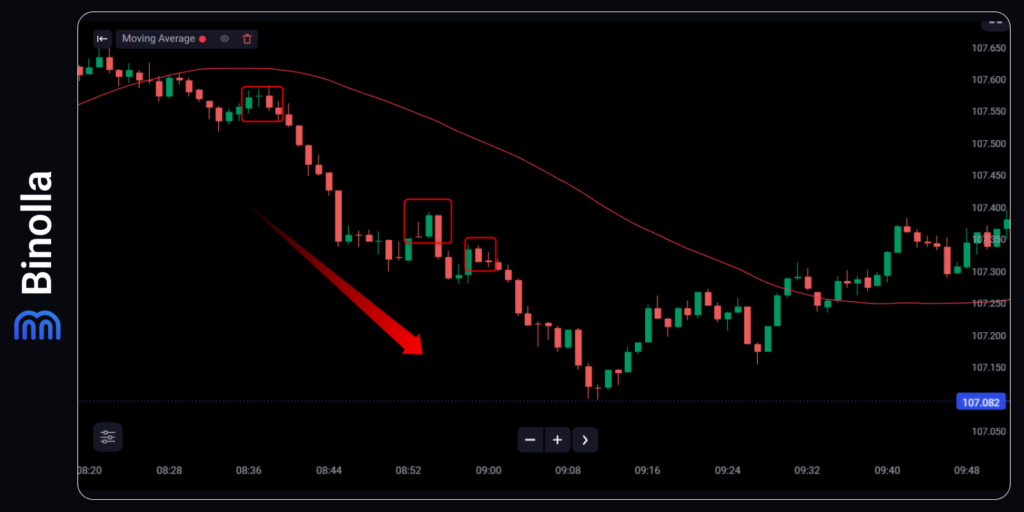
This first approach allows both digital option and CFD traders to find entry points in the direction of the main trend. They use the SMA50 as a trend filter to understand which side is in control. For instance, in the example above, you can see that the price is below the SMA50, which means that the downside trend is confirmed. The only thing a trader should do in this situation is to find upper swings to buy Lower contracts or to sell.
To find these swings, one can use candlestick formations like shooting star, bearish engulfing, evening star, bearish harami, and many others. The idea is to sell or to buy a Lower contract when such patterns appear.

Start Using SMA50 Strategies!
Join Binolla and use your favorite SMA50 strategies with a reliable brokerage
Join nowIf the price is above the SMA50, the same is applied. Traders should look for entries when the price makes lower swings to buy or to purchase a Higher contract. You should keep in mind that this strategy works in trending markets only! Therefore, you should check the slope of the moving average. If the line is neutral, then placing trades can be risky.
Strategy 2: A Pullback Entry with the SMA50
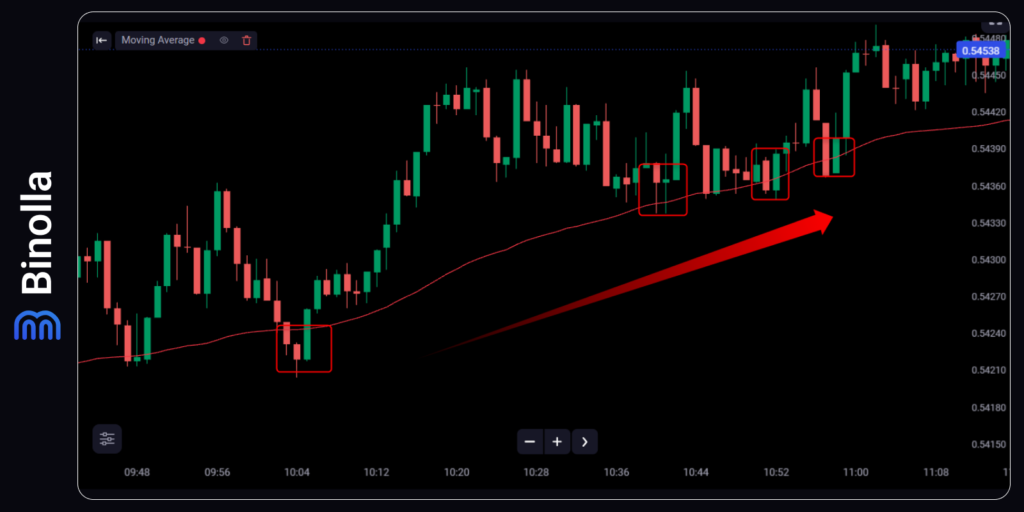
This one is similar to the previous strategy, but unlike the first trading system described in this article, in the second one, the price touches the SMA50 during the trend. The idea of this approach is pretty much the same. A trader enters a trade in the direction of the main trend when the price pulls back to the SMA50, tests it, and then resumes the movement along the trend.
In an uptrend, the price reaches the SMA50 before it moves upward. Traders search for trading opportunities to buy or purchase a Higher contract. Conversely, during the downtrend, the price pulls back to the SMA50 when the downtrend is temporarily exhausted and then resumes the downside movement.
To trade with this strategy, you should wait for a retest of the SMA50 first. Depending on the slope of the moving average and the position of the price, you should check for candlestick patterns.
For instance, if the price is below the SMA50 and moves higher to test it, then you should wait for a reversal pattern like a shooting star, evening star, bearish engulfing, and others. On the other hand, if the price is above the SMA50 and tests the moving average after a downside movement, then you should check for a hammer, inverted hammer, bullish engulfing, morning star, and others.
After placing a trade, digital option traders can wait for expiration, while CFD traders should set stop losses and take profits to better manage their trades. A stop loss order in a buy position can be placed slightly below the SMA50 at a distance that you find appropriate. When the price is below the SMA50, then after selling an asset, you can place a stop loss above the SMA50.
Strategy 3: Trading Reversals Below and Above the SMA50
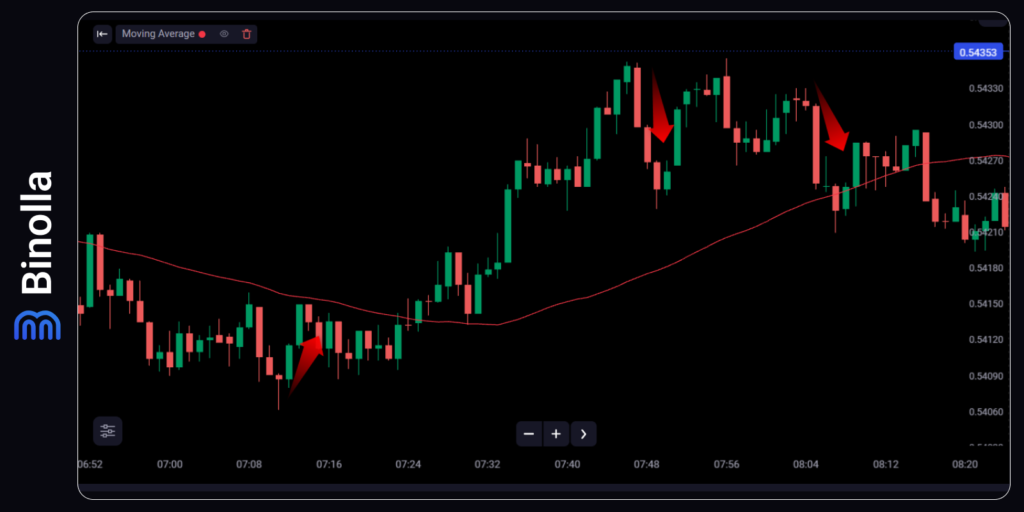
If you look at charts with the SMA50 or any other moving average, then you will see that the price sometimes returns to the moving average after being below or above it. This is where you can build a strategy around this concept. If the price stays below the SMA50, then you can expect it to move higher and reach the moving average at some point to test it. On the other hand, if the price is above the SMA50, then you can expect it to move lower to test the moving average.
What you need now is to understand where these reversals below and above the SMA50 can happen to trade in the direction of the moving average. To do that, you can use the same reversal candlestick patterns.
In our example, the price below the SMA50 reverses after a red hammer candle and then moves higher. Therefore, if you see such a pattern below the SMA50, you can buy or purchase a Higher contract.
When the price is above the simple moving average with a 50-period, then you should look for opportunities to sell or buy a Lower contract. In our example, we have first a bearish engulfing and then a doji.
When it comes to stop losses, you can place them above or below the pattern that you trade. For instance, when it comes to a hammer, you can place a stop loss just below the leg of the pattern. For bearish engulfing, a stop loss can be placed above the formation.
Strategy 4: Combining SMA50 and SMA100
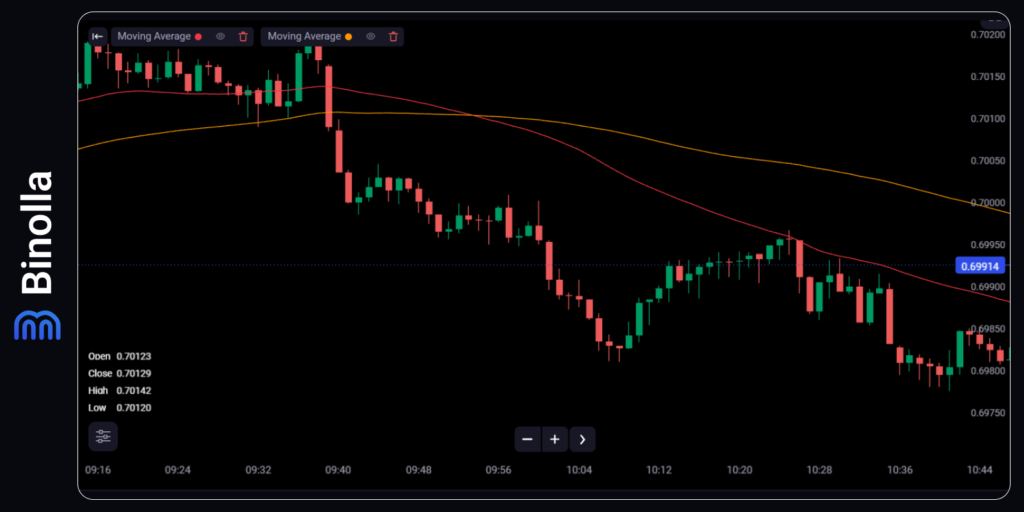
Crossover strategies with different types and periods are very popular among traders. A combination of the SMA50 and SMA200 is a very reliable approach as it shows a switch in trend after a breakout. In our example, we have a so-called Death Cross signal where a faster SMA50 breaks below a slower SMA200 from above.
If you see this, you can buy a Lower contract or sell an asset. The trade should be placed after a crossover is clearly seen. On the other hand, when the price is above both moving averages, and they cross, a bullish signal is formed. You should do exactly the same. After you clearly see a crossover, then you should buy or purchase a Higher contract.
Strategy 5: Breakouts
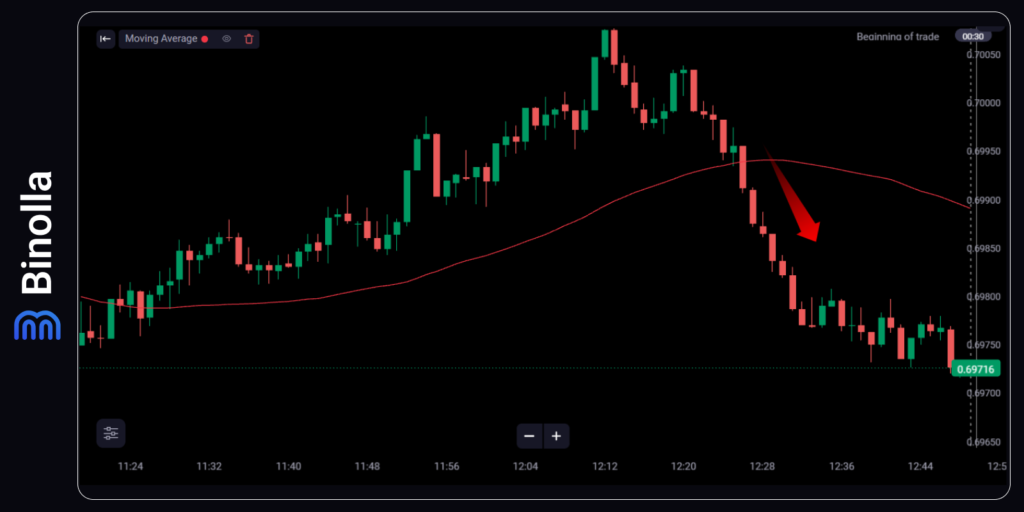
SMA50 breakouts are traded by many professional traders. One of the reasons market participants use this approach is that when the price breaks above or below, the market mood changes. For instance, when the price is below the SMA50 and moves above it, this means that buyers gain control and sellers are no longer controlling the market. On the other hand, when the price stays above the SMA50 and moves below the line, this means that bears are getting control and the market sentiment shifts from bullish to bearish.
How to trade in this situation? The best strategy is to buy a Higher contract or to buy an asset when the price makes a breakout above, and the candle closes. However, some traders use even a more aggressive approach and buy when the very breakout occurs (without waiting for the breakout candle to close).
On the contrary, when the price breaks below the SMA50, traders buy a Lower contract or sell an asset when the breakout candle closes. Similar to the previous approach, some may use a more aggressive approach and engage at the very moment of a breakout.
Strategy 6: Retest
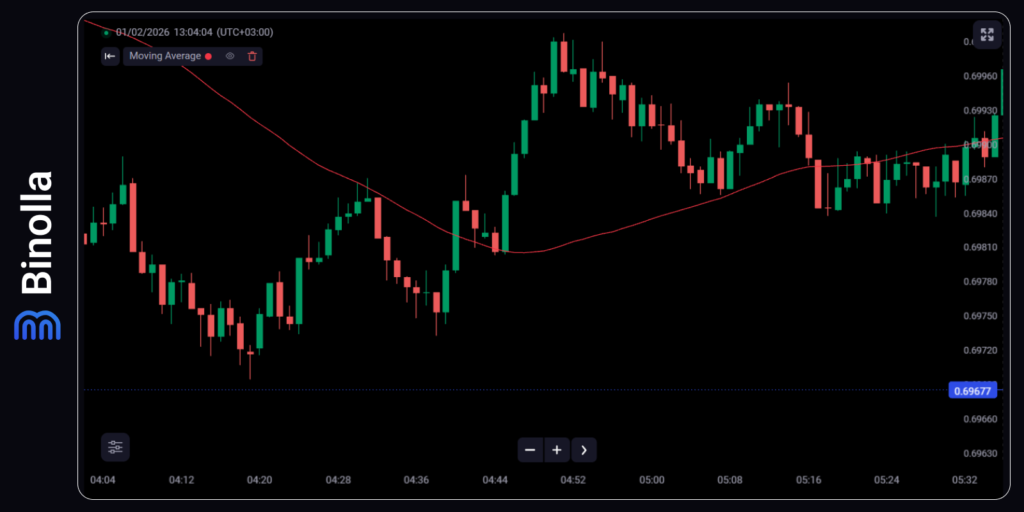
The breakout strategy can be augmented by a retest approach if it happens right after the price breaks above or below the SMA50. Sometimes the price goes upward or downward in a straight directional movement, while in other cases, a retest may take place, where you can add to your positions or buy another digital option.
If the price went above the SMA50 and then returned to test it, then you should prepare for trading. Similar to other strategies with the SMA50, using candlestick patterns will be a great advantage. For instance, in this example, there is a bullish engulfing after a breakout when the price is testing the SMA50 again. Therefore, traders can buy a Higher contract or buy an asset when the green candle of the bullish engulfing closes.
The same is relevant for cases of downside breakouts. If the price immediately goes to retest the SMA50 from below, then you can add to your positions or buy a Lower contract after a downside reversal pattern like shooting star, evening star, bearish engulfing, or any other.
Tips for Using SMA50 Strategies
SMA50 strategies are reliable, but in order to get consistent, you should make it simple and wait for confirmation. Moreover, discipline also matters. Here are some recommendations on how to improve your performance when you use such strategies:
- Combining SMA50 with price action. As you see in most strategies, we are using various patterns to find entry points. The SMA50 itself provides you with information about the market context. Technical patterns allow you to see where to place a trade, which makes your entries precise.
- Overoptimization is the enemy. While you can add some more indicators to improve your strategy, overoptimization may lead to heavier losses. In order to be consistent, you should avoid adding too many indicators or tools that may give contradictory signals.
- Backtesting is the key. When you set up your strategy, you should go through charts and watch whether the approach is really working. Moreover, you can even count the number of signals that you would trade to see the percentage of profitable trades.
- Use the demo account to practice. After watching the performance on charts, you can also spend some time in the demo mode and try your strategies in real-life market conditions.
Conclusion
The SMA50 is among the most popular types of simple moving averages that allow market participants to identify trends, confirm momentum, and find entry points across various types of assets. The strategies explored in this article are the most basic principles of using this moving average for both beginner and experienced traders. You can use them as they are or even improve and augment them by adding various indicator combinations.
FAQ

What is the SMA50, and why is it popular among traders?
The SMA50 is a simple moving average calculated over 50 periods. It shows price dynamics over 50 periods and allows market participants to identify medium-term trends. Traders often use this simple moving average to see price movement direction, dynamic support and resistance levels, as well as spot entry points.
Can I use these strategies for all markets?
Yes, sure. These strategies can be applied for stocks, FX, cryptocurrencies and all other markets. However, you should keep in mind that before applying any of these, you should check the market context using the SMA50.
Which timeframes are best for using the SMA50?
The choice of a timeframe depends entirely on your trading style. For instance, if you use scalping strategies, then you can trade on M5-M15. For those who apply day trading methods, the best timeframes are H1 and H4. Swing traders often use H4 and Daily charts.
How to avoid false signals when using the SMA50?
Unfortunately, none of the indicators help traders avoid false signals. However, there are some tricks that may help you reduce their quantity. First, you can combine the SMA50 with various indicators like RSI. Also, you can use candlestick patterns for better timing.
How to manage risks when using SMA50 strategies?
To mitigate risks when using strategies based on the SMA50, you can set stop losses and take profits. Also, traders use a risk-to-reward ratio (like 1:2 or even higher). Before applying any strategy to your real account, test it in demo. Finally, you should stick to proper position sizing.