The Cycle of Revenge Trading: Why It Feels Right But Destroys Accounts
If you have ever felt this need to open a trade after one or a series of losses, you fell victim to revenge trading. This is a common mistake that most traders make, especially at the beginning of their careers. In this article, you will see the nature of revenge trading. We will provide you with some useful tips on how to avoid it.
Contents
- 1 Revenge Trading Breakdown: Psychology Behind It
- 2 The Anatomy of Revenge Trading
- 3 Make your First Steps in Trading with Binolla!
- 4 Why Revenge Trading is a Bad Habit?
- 5 How to Avoid Revenge Trading
- 6 Conclusion
- 7 FAQ
- 7.1 Is every trade that I take after a loss considered revenge trading?
- 7.2 What if I win when doing revenge trading? Is this a good idea?
- 7.3 How can I see that I’m prone to revenge trading?
- 7.4 What is the difference between revenge trading and averaging down?
- 7.5 Can I eliminate emotions from trading?
Revenge Trading Breakdown: Psychology Behind It
Revenge trading is a psychological aspect that describes the need to open a trade after a loss or a series of losses to win money back. It is based on a blend of emotions and psychological triggers, which, taken together, pave the way for future losses. Understanding revenge trading will help you avoid making such mistakes in the future and make one step closer to your success in the financial markets. Now let’s take a closer look at what triggers revenge trading.
A Blend of Emotions
So, first, when you have a loss, anger and frustration take place. You start considering the market as an enemy. Logic steps back, and emotions take control. This is the moment when you drop your trading system and discipline, and all your further decisions will be managed by a single wish to win back what you just lost.
Another thing that should be mentioned here is that every losing trade hits traders’ ego and pride. Once losses occur, market participants start doubting their own intelligence and skills. Thus, such traders often consider future gains as an attempt to restore their wounded pride.
Finally, the gambler’s mentality is what can cause revenge trading as well. Market participants start chasing losses, which evaporates rational thinking and risk management. The only thing that a trader is obsessed with is the need to break even. They think that a profitable trade should occur after losses, which is similar to a winning combination in casino slots or any other games. Therefore, some traders increase their trading volume to win back as soon as possible, expecting the market to be favorable after being rough to them.
How Our Mind Responds to This Situation
Beyond all these emotions, you should understand what processes go on in your mind when a loss or several losses occur. The brain treats them as a threat. This, in turn, triggers a response, which brings cortisol and adrenaline. Both prevent you from a proper analysis of an asset and block the part of the brain that is responsible for reasoning. Traders end up making bad decisions, which, in turn, lead to even worse consequences.
The Anatomy of Revenge Trading
Now that you know what revenge trade is and how your brain reacts to losses, let’s see what is inside and why a trader switches from systematic and structured trading to chaotic actions. It should be mentioned that revenge trading does not come out of nowhere. It is triggered by specific conditions, which, together, result in a blast. Here are some of the most frequent reasons for a trader to place revenge trades:
- A sequence of small losses. While those losses are manageable taken alone, when they accumulate, they may create frustration. While the trader feels that they do everything right, they are still getting nowhere, and they start thinking that they should do something big to get out of this situation.
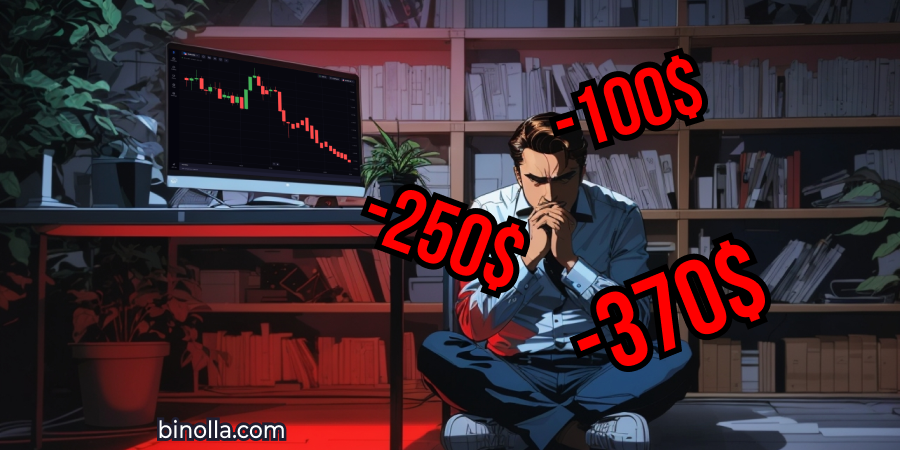
- One large loss. This is another aspect that may trigger revenge trading. In binary options, a trader may gradually increase the amount of investment per trade after having a profitable trade, and at some point, they lose too much. In CFD trading, market participants who do not place stop losses may be trapped by a strong opposite price movement that eats a solid part of their deposit. When this happens, an urgent desire to get things back triggers revenge trading.
- FOMO. While this is not a loss at all, it also triggers revenge trade simply because of the absence of gains. Watching an asset make a serious movement makes you think that the opportunity was stolen from you. Therefore, a trader decides to jump into the market just to catch the opportunity.
- External stress. A bad day at work or some family problems may also affect your trading decisions. You don’t want to close the day with another failure, and after making even one losing trade, you want to fix it and place another trade. Even an acceptable loss can suddenly turn into a true pitfall.
A Step-By-Step Breakdown of the Revenge Trade

Make your First Steps in Trading with Binolla!
Join Binolla now and enjoy the features of a reliable brokerage!
Join nowNow that you see what can cause revenge trading, let’s break down the whole path to it to better understand this dangerous enemy of every trader.
- The trigger. First comes what triggers the desire to win back. This can be a losing trade or even a series of failures. Keep in mind that even if you trade according to your plan and you accept some losses that are covered with profits, there is no guarantee that you will avoid revenge trading.
- The emotional spike. Next, after having a loss or a series of losses, emotions come into play. Traders stop thinking rationally as they want the injustice to be fixed. We have already mentioned ego and anger. The logic center in your mind is blocked at this moment. Instead of remaining a rational analyst, a trader becomes a reactor full of emotions.
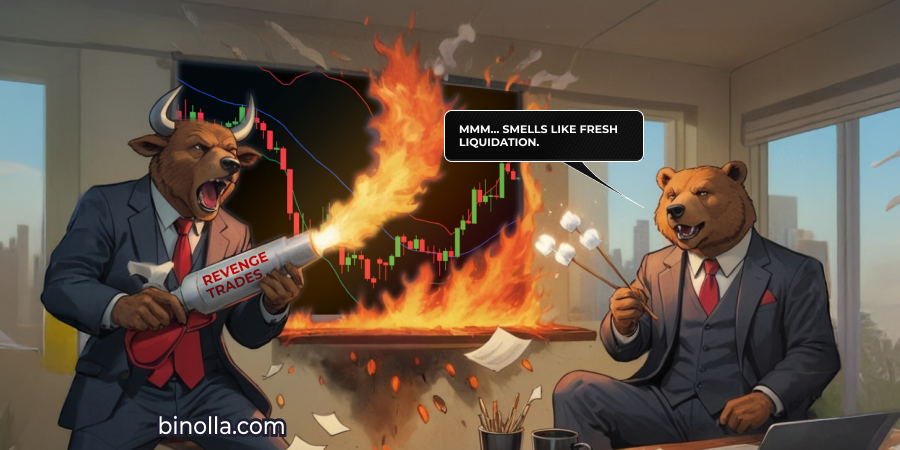
- The reaction. Now that a trader’s mind is boiling with emotions, they decide to open a trade just to take revenge on the market for all the psychological pain they suffered previously. While revenge trading alone is a bad behavior in trading, it will be even worse if a trader decides to cover losses quickly and adds volume to their next positions. This is a kind of Martingale behavior, which may result in devastating consequences.
- Poor Entries. As you may guess, entries in revenge trading are based on nothing. Instead of finding patterns or at least watching the position of the price, traders rush to open trades even in the middle of nowhere simply to be in the market. The risk management is poor as well. It is more about hope-driven gambling than true trading.
- The result. Expecting a positive outcome in this situation is wasting your time. Even if your trade ends with a profit, it will have a negative consequence on your whole trading journey. If you are lucky enough to close a trade with a profit, then this example will tell you that such behavior is normal, and you can fix a losing streak by simply placing revenge trades in the future. This will only postpone a major failure that will definitely hit you in a month or even in a year.
Why Revenge Trading is a Bad Habit?
Some traders who practice revenge trading from time to time think that this is a way for them to win back losses and, thus, fix everything. However, in the long term, they end up losing everything. This happens just because they do not understand some important aspects that should be considered.
The Math Behind Trading
Professional traders know that they can’t be profitable all the time. Even if you have a profitable streak that can last for 10 minutes, one hour, or even one day, at some point, losses will occur. Whatever strategy or trading system you use, they have their profitability rate, which is rarely close to 90%. Most average traders’ profitability rate is about 60-70%. Therefore, to be profitable over time, such traders use various money and risk management tools depending on the financial instrument they trade.
If you open ten trades with a $10 investment and 90% profitability, then with a strategy giving you 60% of profitable trades, you will make $54 and lose $40, which makes it $14 in total. While this is not a big amount, by scaling this situation, you can make a decent amount even over a week, especially when you increase your investment amount gradually in accordance with your growing balance.
A single revenge trade may completely ruin this concept. If you decide to invest $20 or even $30 in a trade simply to cover your losses, instead of making $14, you will end this streak with losses.
The Snowball Effect
What makes revenge trading even more dangerous is that such an approach may accumulate mistakes over time. Even if you lose some tiny amounts at the beginning, at some point, your losses may be significantly higher and even ruin your entire balance. For instance, in the example above, you can place your first revenge trade with $10 and lose, you will still be profitable, as your amount after a series of trades will be $4, even with this loss. However, the problem is that traders rarely stop after a single revenge trade, trying to get back what they have lost at any cost. Therefore, the next trade may be $20, then $30, and so on, until you see that there is no more money to invest. This snowball effect is even more dangerous than a single revenge trade.
Loss of Edge
Professional traders always have an edge, which stands for their statistical advantage that they get when they apply a specific strategy. What is important here is that when you start placing revenge trades, you break this edge and throw it out of the window. If your edge (profitability rate) is 60-70%, then by opening several revenge trades, you may decrease it to 50% and even lower, which will affect your trading results over time.
How to Avoid Revenge Trading
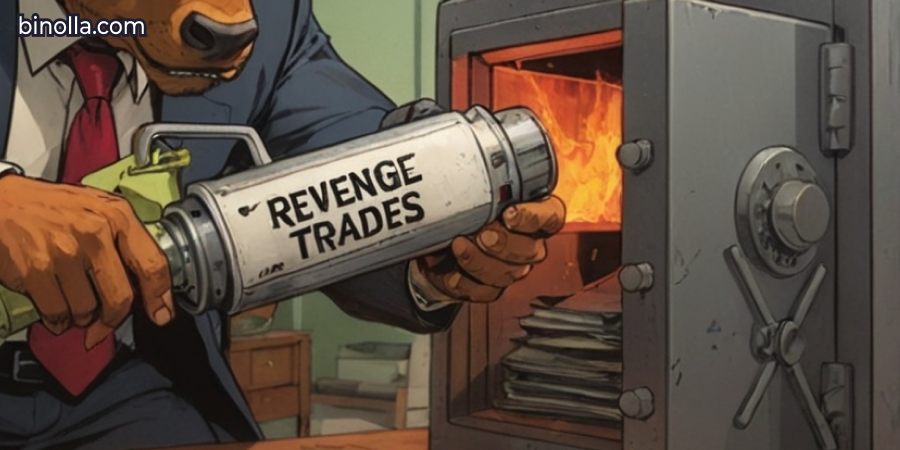
Knowing your enemy is good, but you should also understand how to fight it. If you see that revenge trading is your case, then you should take some steps to prevent this behavior. Here is a plan that you can apply to stop revenge trading.
1: Mandatory Cooldown Period
The first step that you can take is to implement the Hard Stop rule. Regardless of whether you trade binary options or CFDs, once a loss occurs, just leave the market and close the platform for a while. This could take 20 minutes, half an hour, or even more. There is no specific timeframe for that. The idea is that when you get back, you can conduct market analysis before entering a trade, and the loss is no longer vital for your mentality. Sometimes physical training, like push-ups can also be useful, as this will force the adrenaline to dissipate.
2: Lower the Risk
If you think that you still need to open a trade, just lower the trade size to the minimum. Like, if you are trading with $10 per trade, you can switch to $1. While this will keep you engaged, if losses continue to occur, they are unlikely to put you down, and the financial damage will be negligible.
3: Keep a Trading Journal
The next thing that you can do if you can’t handle losses and you feel like you need to enter is to keep a trading journal. Just write there what you felt right after the trade was closed, like “I’m angry as I lost $10 in the previous trade” or “I want to double my position size to cover losses”. By simply naming your emotions, you can better recognize them and, therefore, mitigate their impact on your trading journey.
4: Set Your Environment Properly
Before entering a trade, you can complete a checklist that you can stick to your monitor. For instance, such a checklist may contain preparative steps like checking the Bollinger Bands indicator, finding a pattern, waiting for confirmation, and then entering. By the way, even if you don’t have any troubles with revenge trading, such a checklist can be useful as it will allow you to control how you stick to your strategy and trading plan.
Conclusion
Revenge trading can be treated as an act of self-sabotage. When a trade places such a trade, they become their worst enemy. A trader transforms into a gambler with no risk management tools and impulsive decisions. Knowing how to tackle revenge trading is among the most important skills every trader should have. Overcoming a revenge trader is what separates beginners from professionals.
FAQ
Is every trade that I take after a loss considered revenge trading?
No, if you conduct proper analysis with cold blood and then make a weighed decision, then a trade that you open after a loss can’t be treated as revenge trading. However, if you rush to the market to seize the current movement just because you want to win back what you’ve lost in a previous trade, then this can be considered revenge trading.
What if I win when doing revenge trading? Is this a good idea?
Even if you win when placing revenge trades, there is no reason to justify such an approach. Today you win, but tomorrow you may lose and even more than you won today! The idea is that even if you are lucky in one revenge trade, you may have serious losses afterwards and this is why you shouldn’t consider such profits after revenge trades as good behavior.
How can I see that I’m prone to revenge trading?
Well, there are several markets that will help you understand that some of your trades are nothing more than just an attempt to win back. First, when you place a trade right after a losing one without even properly analyzing the market. Also, if you start using any type of martingale thinking that doubling up your position size will help you win back.
What is the difference between revenge trading and averaging down?
Averaging down can be a part of your strategy. For instance, you may scale down your initial trade, expecting that there is a probability of some further opposite movement before the price moves in your direction. This has nothing to do with revenge trading.
Can I eliminate emotions from trading?
No, it is impossible, and you should not even try. The thing is that controlling emotions is what professional traders do. To become a successful trader, you should build a trading system that will allow you to make decisions based on analysis and use proper money and risk management rules.