Oil Trading in the Digital Age: A Comprehensive Guide
Oil trading has recently become very popular among market participants due to the digital revolution, as retail traders have gained access to this asset through a variety of financial instruments. Contracts like CFDs or binary options made it accessible to anyone without the need to transport or stock oil on their own. What you do when trading oil nowadays is just purchase a contract to speculate on its price fluctuations. In this article, you will learn the basics of oil trading, including factors that affect the black gold, financial instruments that you can use, and some useful recommendations.
Contents
Understanding the Oil Market
The oil market is not just a monolithic structure. When you decide to buy your first contract, you will see that there are two primary benchmarks that affect global pricing:
- Brent Crude. This oil source is from the North Sea. It is an international standard and prices around two-thirds of the traded crude oil in the world.
- WTI (West Texas Intermediate). It is sourced from the US and is the primary benchmark for US oil. This type of oil is lighter and sweeter than Brent.
While both have their differences, they are not affecting the trading itself. The price of Brent oil is slightly higher, but they move almost synchronously, which means that no matter which one you choose, you will trade under the same conditions.
Factors Affecting Oil Prices
Before delving into oil trading, you should also learn and understand the factors that affect its prices. Both Brent and WTI are influenced by an array of factors, from geopolitics to global economic developments.
Supply Dynamics
Oil prices are sensitive to supply disruptions. For instance, the latest tensions in the Middle East, when Iran has blocked the Strait of Hormuz, have significantly affected global oil prices. Iran blocked the Strait, which stopped oil shipments from this region, and thus, oil prices surged significantly. Brent has reached $120+ on its peaks, while WTI managed to surpass $100 before a correction.
Another supply factor is OPEC+, an organization that includes major oil producers in an extended format (Russia included). By extending or cutting production, OPEC+ can directly affect oil prices. For instance, when OPEC+ decides to increase output, oil prices typically plunge due to higher supply levels, while when the organization decides to cut output, prices may move higher.
Additionally, US shale oil producers are also major players in the oil markets. When they increase output, oil prices are under pressure.

Start Trading Crude Oil with Binolla!
Join the Binolla brokerage now and enjoy the best trading conditions for oil trading
Start nowDemand Dynamics
Oil prices are linked to global economic growth. Demand for this commodity becomes higher when economies show positive dynamics. In times of global growth, oil prices move higher, especially when there is no surge in output. Conversely, in times of global recessions, oil prices are under pressure as less demand creates a production surplus.
Seasonal factors also play their role. In summer, oil becomes more popular as it is the driving season, while in winter, more oil is consumed for heating purposes. Markets are also pricing in the transition from traditional to electric vehicles, which is a long-term trend.
Geopolitical Events
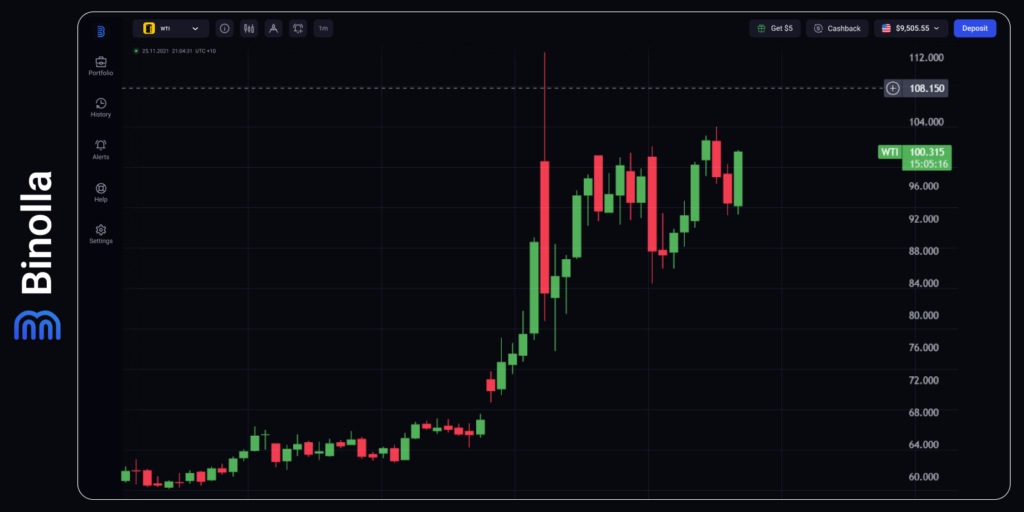
We have already mentioned that geopolitical factors like wars or sanctions on oil producers can affect supply. In particular, conflicts in the Persian Gulf or Latin America, as well as tensions in Eastern Europe, have already had an impact on oil prices. Any of these or those that may happen in the future will be largely priced in.
Inventory Levels and Data Releases
Oil prices largely depend on data coming from the major oil inventories in the United States. Weekly releases of the Energy Information Administration data can play a crucial role in fluctuations. Larger-than-expected inventories always push the price down as they suggest oversupply, while lower inventories may provide additional support to oil prices due to strong demand. Similar reports also come from the International Energy Agency and OPEC.
US Dollar Fluctuations
Oil is priced in US dollars. This means that the connection between oil prices and the US dollar creates an inverse relationship. When USDX goes higher, oil prices move lower, and vice versa, then the US dollar loses ground, and oil prices gain positive momentum. Therefore, to trade oil successfully, you should also monitor the US dollar fluctuations to understand future market trends.
Market Sentiment
This aspect plays a crucial role in trading oil. All market participants that trade oil shape price movements through their long and short positions. The market sentiment is driven by all the above factors, from supply and demand to geopolitics and US dollar trends. In times of crisis, oil is normally under pressure, while during times of positive market sentiment, market participants tend to invest in various risky assets, including gold.
Financial Instruments for Oil Trading
These days, when trading oil was available only to those who shared a seat on traditional exchanges, it is gone. Nowadays, everyone can have access to this asset through a variety of financial instruments. Here are some of the most popular ones:
- Futures and Exchange-Traded Funds. Traditional futures contracts (when you buy a contract that will be executed in the future) are popular among institutional traders. Moreover, to get exposure to this commodity, you can also invest in Exchange-Traded Funds (ETFs) like the United States Oil Fund and others.
- CFDs. Contracts for differences are another way to trade oil in the financial markets. By purchasing one, you buy a portion of oil that you can sell later at a better price. Traders can have even a higher exposure with leverage, which is a type of credit that you can use to buy larger portions.
- OTC trading via binary options. Those who want to benefit from simpler and clearer contracts, instead of planning their risk management strategies or delving into stop losses and take profits, can choose binary options. The OTC format gives you exposure to trading 24/7, allowing you to participate even on weekends and during market holidays. This is a great advantage, as sometimes events may happen even on weekends, and you will be among the first to benefit from the oil reaction to it.
Why Oil OTC Binary Options Trading is Popular
Before moving further, let’s see why so many traders choose oil OTC trading. Unlike traditional trading, binary options are contracts with a fixed risk-reward model, which simplifies trading activities and allows market participants to focus on predicting the prices instead of delving into money and risk management. Yes, you still have to decide how much you will invest in your next trade, but once the position is live, you don’t need to do anything more.
It was already mentioned that binary options are available 24/7, which means that you can react to any events right away and benefit from both range and directional price movements. For instance, sudden news on Saturday can be used to place trades and capitalize on price fluctuations. Other market participants will have to wait until Monday, anticipating the opening of major commodity markets.
Strategies for Oil Trading
When it comes to trading oil using technical analysis, you have a variety of strategies that you can apply depending on your style and expectations. All these strategies that are based on price action or indicators work perfectly. Here are some examples of methods that can be applied.
Reversal Strategies Using Price Action
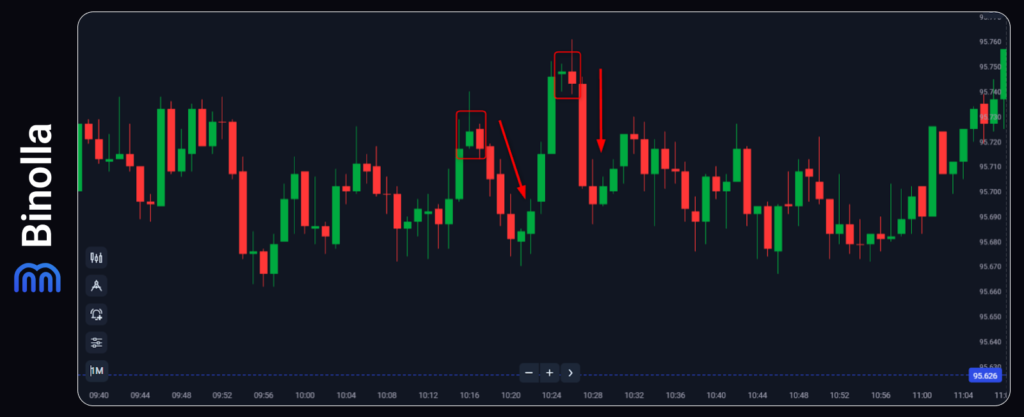
First, let’s look at a strategy where the price reverses after various candlestick patterns. In the first case (on the left), you can see a clear shooting star reversal formation, which is augmented by the bearish engulfing pattern. Here, you can react right away after the shooting star pattern, or even if you are late, the next red candle forms a bearish engulfing pattern.
How to trade in this situation?
- You wait for the shooting star candle to close.
- You buy a Lower contract.
- Wait for expiration.
If you are using CFDs, then before the second step, you should place a stop loss above the highest point of the shooting star candle to protect yourself from excessive risks. As for the target, you can set it according to your risk-to-reward model or simply wait for an opposite reversal signal to close your position.
In the next example, we have a green hanging man candle, which is followed by a shooting star. Again, you can react right after the hanging man closes or wait for the shooting star to close.
Breakout Strategies
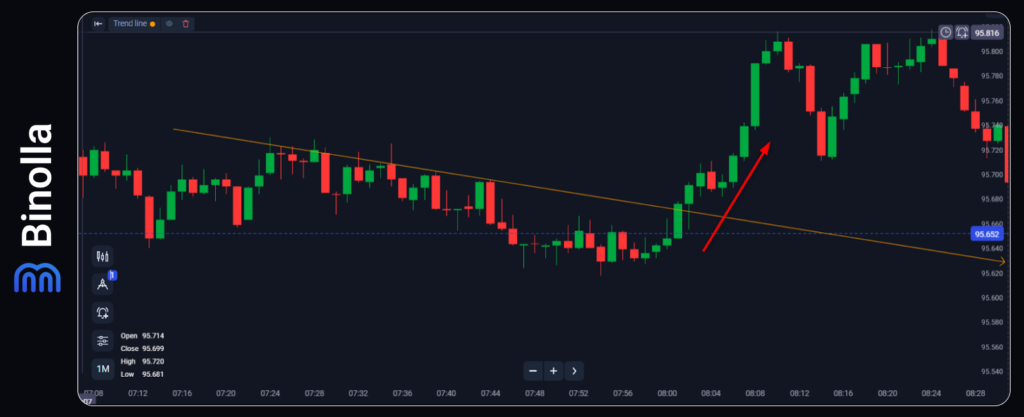
The next strategy allows you to trade along the trend, almost at the beginning of a directional price movement. As you can see, the price moved below the descending trendline for some time, which allowed traders to benefit from this downside movement. However, at some point, the price tests the descending trendline and breaks above it. How to trade in this situation?
- Wait for the price to approach the trendline from below.
- Be patient and open a trade only when the price closes above the trendline.
- Press Higher at this moment.
- Wait for expiration.
Again, CFD traders should place stop losses before they enter a trade. A stop loss can be placed below the candle that has broken the trendline. When it comes to targets, you can wait for a reversal signal to close your position.
Fundamental Strategy
To trade oil successfully, you can use fundamental strategies. To apply them, you should follow the latest news that may affect supply and demand. For instance, if any tensions in the oil-rich regions occur, then the supply is likely to decline, which means that oil prices may surge.
Also, check OPEC+ statements about output. If they increase output, this will increase supply and may put pressure on the oil prices. Onthe other hand, if OPEC+ decides to decrease output, the supply will decrease as well and oil prices may surge.
Using these strategies will help you better navigate in the world of oil trading and provide you with profitable opportunities.
Conclusion
Trading oils is a unique blend of fundamentals and technical factors. With the emergence of modern technologies, a lot of retail traders have gained access to this market via ETFs, futures, CFDs, and binary options. Nowadays, trading is available 24/7 with binary options and OTC assets, allowing you to be among the first to react to all fundamentals. Now that you know how to trade this commodity, you can create an account at Binolla, choose between Brent and WTI, and place your first trades.
FAQ
What is the difference between WTI and Brent?
The difference between these assets lies in their composition and the geographical position of production. WTI sources from shale fields in the US and the Gulf Coast region, while Brent is produced in the North Sea.
What is the best time of day to trade oil?
The highest liquidity comes during the overlap of European and American sessions. Moreover, some volatility may come when the US data is released, as it may impact the US dollar. When it comes to OTC markets, the liquidity is supported 24/7, which allows you to benefit from price fluctuations all the time. Also, you can check for the most important data releases or trade during important news and announcements to benefit from higher liquidity.
How much capital do I need to start trading oil?
Nowadays, you don’t need to have much money at hand to start trading oil. For digital options trading, it is enough to invest from $10 to place your first trade. However, to start making money and protect yourself from breaching money management rules, it is better to start from $50 or even $100.
Can I trade oil on weekends and holidays?
Yes, sure. While traditional markets are closed on weekends and during national holidays, OTCs are available around the clock. This means that you can buy binary options contracts at any moment and be sure that the trade will be executed. This is particularly valuable as you can react to various geopolitical developments or OPEC+ announcements that may occur on weekends.
What is the most important economic indicator to watch?
All indicators are important, but in times of geopolitical stability, reports from the Energy Information Administration are among the key influencers. They are published every Wednesday. A significant deviation from market expectations can cause serious price fluctuations.