Double Top and Double Bottom in Binary Options and CFD Trading: Catching Reversals like Pros

Double top and double bottom are popular technical patterns allowing traders to capitalize on price reversals. Whether you are trading binary options or CFDs, you can use these formations and improve your trading results. By reading this article, you’ll learn more about how double top and double bottom patterns work and how to apply them in trading. Also, we will provide you with some useful tips on how to avoid traps when working with such graphic formations.
Contents
- 1 Double Top: Anatomy of the Pattern
- 2 Double Bottom Pattern Anatomy
- 3 Double Top vs. Double Bottom
- 4 Trading the Double Top
- 5 Start Using This Pattern with Binolla!
- 6 Trading the Double Bottom
- 7 Important Tips on How to Recognize and Use These Patterns
- 8 Conclusion
- 9 FAQ
- 9.1 Are double tops and double bottoms reliable?
- 9.2 What’s the difference between a double top and a failed breakout?
- 9.3 Can I trade double tops and bottoms on lower timeframes (e.g., 1-minute or 5-minute charts)?
- 9.4 How much should the two peaks (or troughs) be separated in time?
- 9.5 What happens if the second top is slightly higher or lower than the first?
- 9.6 What’s the best stop loss placement?
Double Top: Anatomy of the Pattern
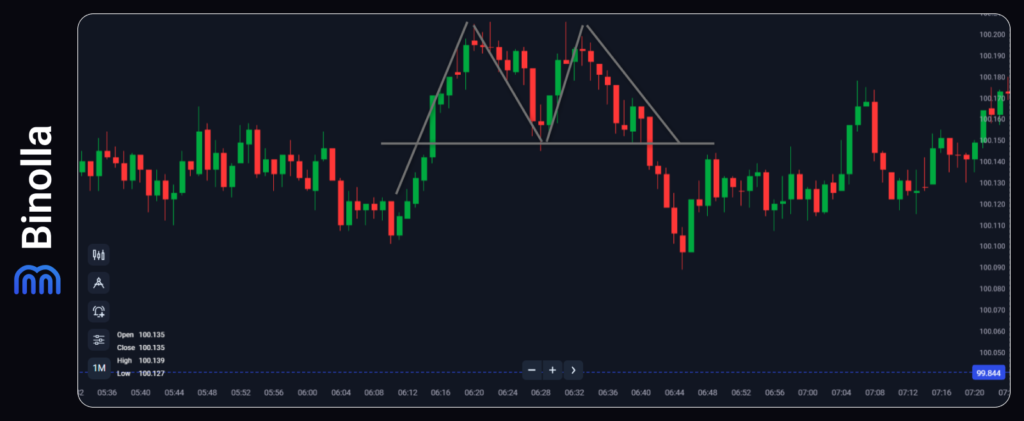
The double top pattern appears at the resistance level after an uptrend. It tells traders that the upside movement is nearing its end and a downside reversal is possible. The double top contains the following parts:
- The left peak is the first top of the pattern, after which a correction begins.
- The dip. This is a middle point on the chart, which is formed after the left peak, where the price reverses again towards the resistance level.
- The right peak is the second peak of the pattern, which confirms that buyers are unable to push the price higher.
- The neckline. This is a support level, which is drawn through the dip point.
As you can see in our example, the double top pattern looks like an M letter. Knowing this shape will help you identify the pattern with ease.
Double Bottom Pattern Anatomy
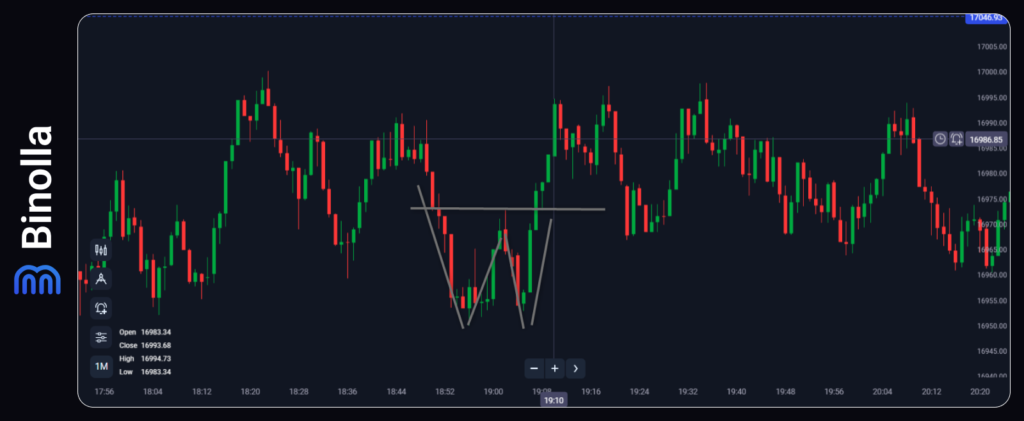
Unlike the double top, the double bottom pattern is formed at the bottom of the market after a downside movement. The formation tells market participants that the downtrend is over and an upside reversal is possible. The pattern consists of the following parts:
- Left dip, which is the first testing of the support level after the downtrend.
- Middle peak. After testing the support level, the price makes its first upside move and hits the first peak point, where a downside reversal takes place.
- Right dip. This is another bearish attempt, which is stopped at the support level.
- Neckline. This is a horizontal line that is drawn through the peak point. This line is used in strategies based on double top and double bottom patterns.
Now that you know the anatomy of both patterns, let’s compare them.
Double Top vs. Double Bottom
To better understand both patterns, you should know their main features. This comparison table outlines the most important ones.
| Feature | Double Top (Bearish Reversal) | Double Bottom (Bullish Reversal) |
| Pattern Shape | M-shape | W-shape |
| Prior Trend Required | Uptrend | Downtrend |
| First Peak/Trough | Peak 1 (high) | Trough 1 (low) |
| Pullback Direction | Downward (to neckline) | Upward (to neckline) |
| Second Peak/Trough | Peak 2 has almost the same height as Peak 1 | Trough 2 has almost same depth as Trough 1 |
| Neckline | Support level connecting the two valleys | Resistance level connecting the two peaks |
| Breakout Direction | Below the neckline | Above the neckline |
| Breakout Confirmation | Candle closes below neckline | Candle closes above neckline |
Trading the Double Top
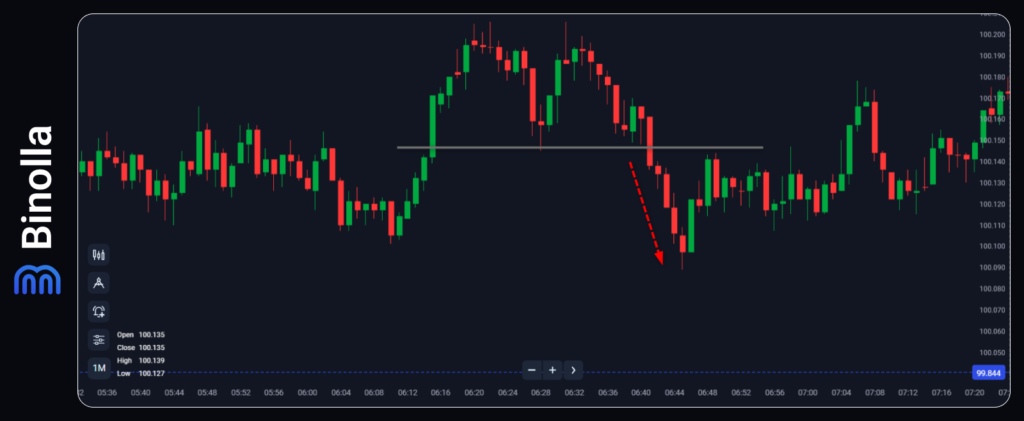
The double top pattern can be traded in three main ways. Traders use aggressive, conservative, and retest strategies. The most popular one is conservative, and you can see this recommendation in most guides. However, the aggressive one can be used by CFD traders to increase the amount of pips they will gain during the upcoming downtrend. So, let’s check each one.

Aggressive Double Top Trading Strategy
The first method requires traders to place a trade at the top of the second peak. This is not just a pure double-top trading strategy, as you can’t say that this is a double top until you see that the second peak turns into a downside movement towards the neckline support. However, this method is often used by aggressive traders who want to collect more pips before the real pattern starts working.
To trade using this strategy, you should check for any reversal patterns at the top of the second peak, like shooting star, hanging man, bearish engulfing, etc. If you find one, you can sell an asset once the pattern candle closes so that you can have confirmation. The first target in this case will be at the neckline.
When it comes to stop losses, you can place them right above the resistance level at the second peak or above the reversal pattern.
Conservative Double Top Trading Strategy
This strategy can be used by both CFD and binary options traders. The idea is very simple:
- Wait for the price to break below the neckline.
- Check whether the candle closes below this support level.
- Buy a Lower contract or sell the asset.
This is a classic double top strategy that works according to the rules of the pattern. When it comes to stop loss, you can place it above the neckline. The target here should be equal to the distance between the second peak and the neckline.
Retest Entry Strategy
This method is the most conservative strategy. You should not open the trade right after the breakout. Wait for the price to retest the neckline from below and then place a trade. The method is not popular among traders, as in some cases, there will be no retest due to increased volume. Therefore, it is recommended for traders to use a classic conservative strategy.
Trading the Double Bottom
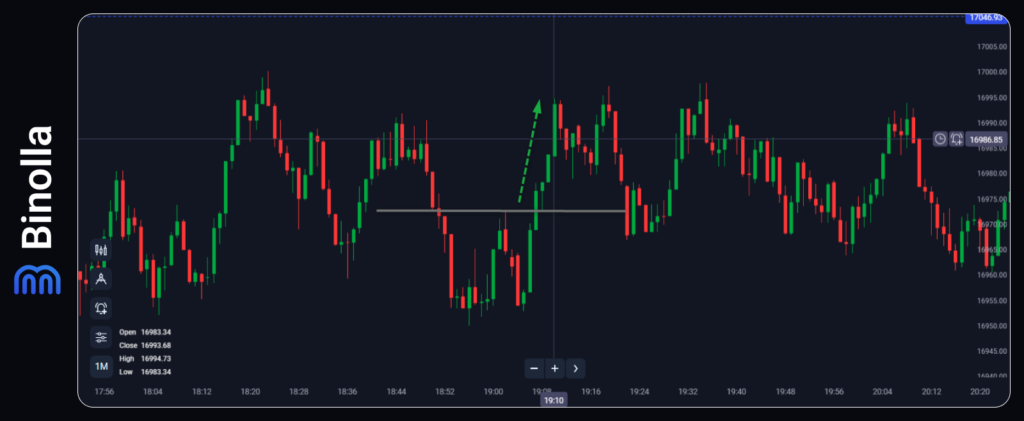
Similar to the double top, the double bottom pattern can be traded aggressively, conservatively, or after a retest. Conservative is a classic strategy that can be used by binary options and CFD traders. We are going to consider all three methods below.
Aggressive Double Bottom Strategy
The trade can be opened at the support level if you find any reversal pattern, like a hammer, an inverted hammer, a bullish engulfing, or any other. Also, sometimes CFD traders buy from there even without patterns, expecting the price to move higher after a second test of the support level. This strategy is not a classic one, as not all the conditions of the double bottom pattern are met. This is why it is not the most popular approach. However, CFD traders can expect higher profits if they start at this point and the price follows their forecasts.
Conservative Double Top Strategy
The classic strategy is based on the neckline breakout. To use it, you should wait for the price to break above this level, then for the candle to close, and only after that, you can buy or purchase a Higher contract. If you are trading CFDs, you can place a stop loss below the neckline and a take profit can be calculated as the distance between the bottom and the neckline.
Retest Double Bottom Strategy
This one is applicable after the breakout of the neckline is done, and the price then goes back to it for a retest. Similar to the double top pattern, you buy from there. However, the strategy is not very popular among traders, as in about 50-60% of cases, a retest may not occur at all. Therefore, you will simply lose a trading opportunity.
Important Tips on How to Recognize and Use These Patterns
To trade with these patterns successfully, you should consider several factors. Here are some of the most important ones:
- Spacing matters. Both patterns look like M and W shapes. The more your pattern looks like these shapes, the better. Also, look at the number of candles between peaks or dips. It should be between 5 and 50. If these conditions are not met, then you should still look at what is going on with the price, but be more careful.
- Trading during low volatility. Low volatility periods are not favorable for double top and double bottom patterns. The pattern starts working with rising volume. If not, then you can skip it. In times of low volatility, another peak or dip may appear. Then another one, and this may happen until volumes are added. Therefore, instead of a double bottom or a double top model, you may see a classic range.
- Do not trade these patterns during major news events. While news trading can be profitable, most patterns may fail, as sometimes the price goes in both directions at the moment when the data is released.
Apart from these recommendations, you should also consider some cases and how to behave if one occurs:
- The price breaks the neckline and then moves back inside. This is known as a fake breakout, which may happen when you trade this pattern. To mitigate such risks, it is recommended to wait until the price closes outside the pattern before placing a trade.
- The price hits the stop loss and then reverses in your direction. If you are trading CFDs and the price hits your stop loss, you shouldn’t enter right away. It is better to wait for another pattern to avoid revenge trading behavior.
- The price failed to reach your take profit level. CFD traders may find themselves in a situation where the price moves in their direction but fails to reach the target. Traders can use trailing stop orders to protect part of their profits.
- The pattern shows up but there is no movement. Sometimes there is not enough volume for the price to make a breakout when it is close to the neckline. In such situations, you should consider range fluctuations and use standard breakout strategies for trading.
Conclusion
Double top and double bottom are known technical patterns that are very popular among professional traders. They are very simple to understand and to find. Moreover, the pattern works in 60-70% of cases, which makes it a reliable structure to trade with. The formation can be used by both CFD and binary options traders. Each pattern has three ways to be traded, from aggressive to very conservative. You can choose any or even use all of them depending on the situation.
FAQ
Are double tops and double bottoms reliable?
Yes, they are reliable and considered among the best graphical patterns so far. The formation is universal, and it works on various timeframes. While it is mostly considered to be applied to H1 and higher timeframes, binary option traders can also find it frequently on minute scales. However, fakeouts are also possible, so you should be on guard.
What’s the difference between a double top and a failed breakout?
The difference between them is that the double has two distinct peaks, while a resistance breakout, which has failed, will have some attempts with upside wicks, which will tell you that this is not a double top. However, both may lead to a strong downside. Therefore, most professional traders treat them as a single pattern.
Can I trade double tops and bottoms on lower timeframes (e.g., 1-minute or 5-minute charts)?
Sure, you can. If you find such a pattern on your 1-minute chart and it forms like a classic double top or double bottom, you can trade it as a standard pattern. This is a good idea for binary options traders as they often choose smaller timeframes to capitalize on price fluctuations.
How much should the two peaks (or troughs) be separated in time?
The distance between the two peaks of the pattern should be between 10 and 50 candles. If the peaks are too close to each other, this may form a rounding top, which is not the double top pattern. If the distance is more than 50, this may indicate a different pattern or trend shift.
What happens if the second top is slightly higher or lower than the first?
If the second top is slightly higher or lower than the first one, the pattern still can be considered valid. However, in this case, it is not recommended to use the aggressive strategy as you can’t be sure that the resistance level will hold the price. The best way in this case is to wait until the neckline is broken before entering the market.
What’s the best stop loss placement?
If you are trading the double top using the classic strategy, then you can place a stop loss order above the neckline. When it comes to the double bottom formation, placing a stop loss below the neckline would be a great idea. You can also place a stop loss depending on your risk-to-reward strategy.